Summary
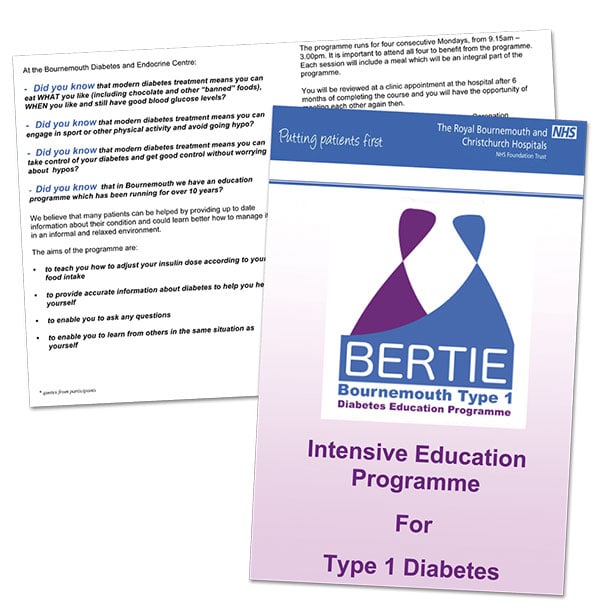
Royal Bournemouth Hospital's BERTIE structured education programme is an appropriate means by which people with type 1 diabetes can learn the knowledge and skills necessary for optimal self-care. Started in 1999, it is run over four weekly sessions. Effectiveness has been measured since its inception by collecting biomedical data and a patient satisfaction questionnaire, with a robust quality assurance programme in place. As a result of continued monitoring of the programme, it has evolved to reflect the needs of patients and improve our outcomes. It has shown sustained biomedical improvement over five years, reduction in emotional distress and reduction in hypoglycaemia and hypoglycaemia awareness. Patients also achieve their self-management goals.
Results
A total of 565 patients have attended BERTIE (aged 16-84 years with duration of diabetes from six months to 54 years). Results show a significant reduction in HbA1c maintained for at least five years. 61% (n=276) of the 452 patients with HbA1c >58mmol/mol showed a reduction in HbA1c. Mean HbA1c reduced from 76.9mmol/mol to 73.9mmol/mol at 1 year (p=0.000) and to 72.4mmol/mol at five years (p=0.000). Mean PAID scores reduced from 23.02 to 16.42 (p=0.000). 80 participants reported third-party assistance for hypoglycaemia prior to BERTIE. At one year, 47 provided information of whom 35 (74%) reported no further such episodes after BERTIE.
50 people reported reduced hypoglycaemia awareness prior to BERTIE. Twenty seven provided information at one year of whom 16 (60%) had regained awareness after BERTIE. 95% of patients 'completely' or 'mostly' achieved their self-management goals.
Challenge
People with type 1 diabetes require knowledge and skills to enable them to understand the effects of lifestyle on their diabetes and vice versa, and how they can manipulate their treatment to enable them to lead the lifestyle of their choice while maintaining stable blood glucose control. They also need information on the consequences of poor control of their diabetes so they can make informed choices in setting appropriate personal goals for the management of their diabetes. In 1997, patients with Type 1 diabetes had little knowledge about carbohydrate content of food, insulin dose adjustment, management of hypoglycaemia and hyperglycaemia, and the effect of exercise and other factors on blood glucose levels. There was no structured programme and average HbA1c in 1997 for patients under 40 years was 9.9%. A local survey showed 60% of patients never adjusted their insulin.
Objectives
To provide support to people with diabetes to enable them to develop realistic short term and long-term management goals. To help them acquire the knowledge and skills necessary to achieve those goals.
Solution
In 1998, the Bournemouth Diabetes Team observed a five day structured type 1 education programme in Dusseldorf, Germany. The team adapted the aims and objectives to develop their own structured programme called BERTIE. The first programme began in May 1999. BERTIE is a standard part of all type 1 care pathways and is offered to anyone who wants to improve their control. We run 7-8 courses a year in a local community centre on four consecutive Mondays from 9am to 3pm. There are 6-8 patients in each group and it is facilitated by a diabetes nurse and dietitian with contributions from a clinical psychologist and consultant physician. Following referral to the programme patients receive a written invitation. Each educator is BERTIE trained, peer reviewed and follows an Educator mentoring plan. The programme which is quality assured, has a defined Philosophy and written curriculum derived from social learning theory. Patients identify barriers to behaviour change and develop strategies to overcome those barriers. The course is supported by a workbook. Self-management goals are set at week 1 and reviewed at the end of the course. There is emphasis each week on insulin dose adjustment and carbohydrate counting. There is on-going data collection – biomedical and patient satisfaction. Demographics and HbA1c are collected at baseline, six months and one year until five years after completion. Patients are reviewed by a consultant in the hospital six month post course and at one year when further data is collected.
Learnings
BERTIE continues to be an effective intervention leading to a significant reduction in HbA1c and diabetes-related distress which helps patients achieve their self-management goals. The reduction in HbA1c is maintained for at least five years. Following the success of the course, training for healthcare professionals from all over the country is offered to learn the skills to run a similar programme in their locality.
Evaluation
Pre course data collection:
- (from 1999) HbA1c, weight, BMI, hypoglycaemia and hypoglycaemia awareness;
- (from 2005) PAID, HADS;
- (from 2010) HFS. All measures are repeated at six months and one year.
HbA1c is collected for fi ve years. BERTIE is audited annually against defi ned criteria: - reduction in HbA1c and PAID,
- achievement of patient management goals,
- reduction in frequency of severe hypoglycaemia and
- increased hypoglycaemia symptom awareness.
Patients complete an evaluation form at the end of the course