Summary
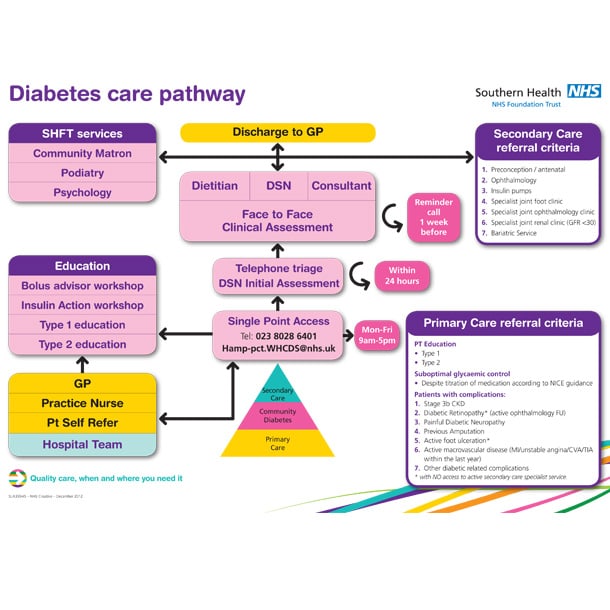
In a redesign of the diabetes treatment pathway, adult patients with diabetes now have a single point of access and are triaged by a diabetes nurse telephoning each patient. The service provides type 1 and 2 education and multidisciplinary clinical appointments throughout West Hampshire, in addition to a nurse-led telephone advice line open Monday to Friday 9-5pm. There is also a primary care education programme in place to support GP and practice nurse initiation and adjustment of insulin and GLP-1 therapies. The infrastructure is built around a remotely accessible IT package. Feedback about the education courses and appointments has been positive, while there have been improvements in the number of patients achieving glycaemic targets and a reduction in hypoglycaemia admission rates.
Results
Face-to-face appointments and education were delivered in the community. Type 1 and Type 2 diabetes education courses feedback was good or very good in 100% and 95.1% of cases respectively. Extremely positive answers were given to the question ‘Would you recommend the course to family or friends?’ and 92% of respondents rated the appointments service as good or excellent. Almost all patients agreed they were involved in decisions regarding their care. Furthermore, QOF data shows consistent improvement in patients achieving glycaemic targets over a three-year span and hypoglycaemia hospital admission rates fell by 8% in the same period.
The service established good relationships with primary care, the voluntary sector, community care teams, commissioners and acute-service clinicians. Before it was established, diabetes outpatient appointments comprised 717 new and 5,488 follow-up at a cost of £616,279. The WHCDS provided 7,412 appointments (divided between a consultant, nurses and dieticians) at a cost of £490,000. The cost per head of population has reduced from £30.85 to £22.43 a saving of 27%.
In addition, despite an increase in diabetes list size of 9% over two years. Follow-up ratios have decreased by over a third.
Challenge
The West Hampshire Community Diabetes Service (WHCDS) was launched in 2010 in response to a health system that was struggling to manage the growing number of diabetes patients, and inequity of service provision.
A service was needed to prevent illness and maintain wellbeing, provide earlier diagnosis and better care to reduce complications, support patients in self-management and support and educate primary care staff, thereby encouraging care management back into the community.
A steering group included clinicians and managers from local service providers and the PCT. The service has challenged traditional delivery of patient care in acute hospitals and moved it to the community. Evidence from the Chronic Care Model was used to inform the steering group’s work and was key in identifying important areas for development.
A diabetes locally enhanced service also supported the launch of the service, which encouraged primary care to take on the initiation of GLP-1/Insulin therapy.
Objectives
Qualitative targets included improving the patient experience, reducing the number of care providers to offer better continuity for patients, improving the availability of high-quality Type 1 and Type 2 diabetes education courses for patients, and delivering an education programme for staff. The project also aimed to develop a network of education meetings for staff along with a regular newsletter and to grow stronger stakeholder relationships with primary and secondary care and patient groups.
Solution
Quantitative targets were to reduce new to follow-up ratios, improve QOF outcomes for HbA1c and reduce hospital admissions.
For these objectives to be met the service had to be defined, a communication strategy had to be implemented, an IT solution was required and all these elements needed to be monitored and evaluated.
Evaluation
Early in the project it was recognised that developing clinical leadership skills across the team was vital to the success of significant transformational change. Team away days and input from occupational psychologists have embedded this approach in the service.
The Chronic Care Model provided an important foundation to the project’s work. A recent systematic review confirmed the relevance of the elements of the model, which is little known among the professional diabetes community in the UK.
The project worked hard to develop a communications strategy that allows its messages to be clear, consistent and delivered to all stakeholder groups. Equally importantly, there are built-in mechanisms for stakeholder feedback. In June 2012 an open forum enabled local GPs, practice nurses, commissioners and others to challenge ideas and make suggestions. A summary report was circulated within 24 hours.
While IT is often a barrier to new ways of working, we have liberated our community service by identifying a way to access information, wirelessly throughout our wide community geography and across two acute trusts.
Impact
The community diabetes model is evidence-based and readily transferrable. The Chronic Care Model could apply to many service redesign projects but is little recognised in the UK. It provides a framework for better understanding of the features of a successful system. Local interpretation is vital to the success of community projects, all of which will have a unique set of needs according to their geography, socioeconomic status and ethnicity.
Currently local models are difficult to compare and contrast. The impact of a community diabetes service is broad and the measures used to assess it need to reflect this. WHCDS sought to influence local data collection; making early contact with local surgeries that had not submitted data to the National Diabetes Audit and linking them with the NDA for assistance. Submission rates in Hampshire have now risen from 70.5% (2010/11) to 95.14% (2011/12).
Quality markers are an important part of monthly data review and professor Don Berwick cites six markers of a quality service: That they are safe, patient centred, effective, timely, evidence-based and offer value for money. Evidence shows WHCDS achieved progress in each of these areas and continues to drive improvements.