Summary
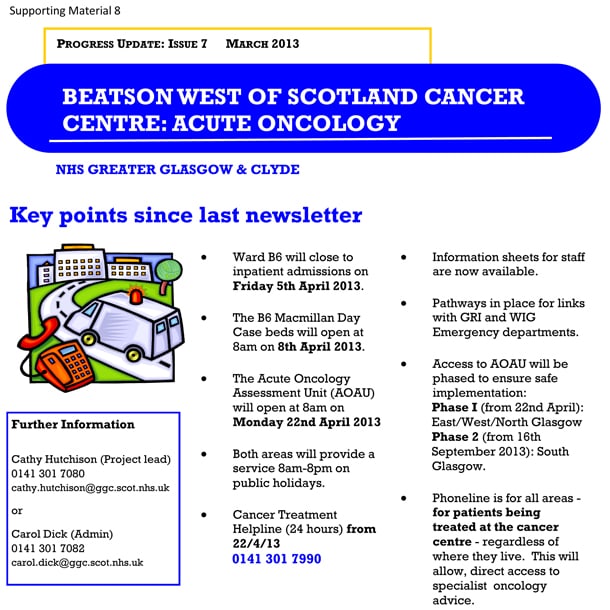
A combination of strategic reports and guidance, in addition to experience and local audit, led the Beatson team to develop a redesign proposal for increasing day case chemotherapy capacity, establishing a 24-hour telephone helpline to better support patients and staff, and an assessment unit to review patients timely and effectively.
The aim was to improve unscheduled care for patients with cancer, and to meet the increasing demand for day case chemotherapy. The Acute Oncology Assessment Unit (AOAU) is an 8-bedded nurse-led day case area where all emergency admissions to the cancer centre, patients presenting to clinics unwell, and those who become unwell during radiotherapy or chemotherapy treatment, are seen. Patients phoning the helpline can also be seen in AOAU avoiding the need to attend the Emergency Department.
Challenge
Reports identified issues such as prevalence of cancer patients in acute service beds, inadequate communication and IT, and poor patient access to specialist advice and care 24/7.
An audit at the Beatson West of Scotland Cancer Centre BWoSCC showed variation amongst staff and practice about what information to give patients on treatment, what to do if they were unwell and what advice to give patients at home. Patients were unsure who to phone for advice, and contacted various sources. This resulted in patients receiving advice of varying quality.
A combination of strategic reports and local audits prompted a redesign proposal for increasing day case chemotherapy capacity, establishing a 24 hour telephone helpline, and setting up an assessment unit.
Objectives
Among its objectives, the team wanted to establish an eight-bed Acute Oncology Assessment Unit (AOAU) and a 24 hour Cancer Treatment Helpline (CTH/helpline) within the AOAU. They aimed to increase chemotherapy day case capacity by reconfiguring existing inpatient resources to include an additional 11 day case beds.
The specific objectives of the AOAU and Cancer Treatment Helpline were to assess and manage patients dealing with the complications of cancer treatment, and to provide improved access to specialist oncology advice and care, at the right place at the right time.
Solution
A multi-professional steering group was established to oversee the initiative. There were nine subgroups: staff governance; communication; day case service model; AOAU service model; staffing model; pharmacy services; education & training; and evaluation & financial. Each subgroup developed an action plan and was governed by the project steering group.
Baseline evaluation was undertaken, influencing the need to phase the implementation on a geographical basis in terms of AOAU attendance. Communication was crucial across the subgroups and with a wide range of groups and stakeholders. The project had a communication strategy to guide this.
Funding was sourced from Scottish Government Cancer Modernisation and Macmillan Cancer Support. Cost savings were achieved from the overnight bed savings and some of this has been redirected to staffing the AOAU with the necessary higher staff to patient ratio, to ensure sustainability of the service.
Results
There was a number of benefits to patients, including effective and efficient management of oncological emergencies such as MSCC and neutropenic sepsis.
All patients attending AOAU with suspected MSCC received an MRI scan within 24 hours of attendance, while 92 per cent of those with suspected sepsis received IV antibiotics within the hour. All received the Sepsis 6 care bundle.
Patients also benefited from 24 hour access to a specialist oncology professional (approximately 400 calls were taken each month).
The organisation benefited from better bed management, and AOAU relieved pressure on wards, by assessing and treating all emergency admissions coming to the cancer centre. AOAU also relieved pressure on local emergency departments.
Benefits to staff include the helpline providing support and advice to non-specialist workers, including primary care.
Learnings
This was a challenging project, initially lacking a common vision and encountering resistance to change. Time was invested in working with staff groups to develop the shared vision and ownership. The team worked to maintain focus on why they were doing it and the benefits to patients.
The team hired an Advanced Nurse Practitioner with significant acute medicine experience, but limited oncology experience. This was not universally supported, but proved invaluable in developing the AOAU, and in training and supporting staff, complementing existing oncology expertise.
There were substantial human resources challenges for nursing staff, the new service model requiring a different shift pattern and skill mix. Early engagement with staff and unions was crucial and communication with all stakeholders was key.
Evaluation
Additional benefits that had not been primary aims, included improved medical on-call arrangements, a new formal process for high dependency reviews and admission for oncology patients, and a more structured phone assessment for patients who call the wards without being on active treatment.
The work is transferrable to any cancer treatment centre, as all are facing similar challenges in terms of capacity and governance. Standard operating procedures, evaluation plans, and clinical pathways could all be shared. There have already been a number of teams visiting with a view to developing their own services.
SEPSIS 6 standards, as implemented in the AOAU as a nurse-led model, could be implemented elsewhere, as could the triage centre set-up for patient phone calls.