Winner
St Helen’s Young Adult Diabetes Service
by Mersey and West Lancashire Teaching Hospitals NHS Trust
Executive Summary
In one of England’s most deprived regions, St Helens Hospital revolutionised diabetes care for 18–25-year-olds through a co-designed, multidisciplinary model. Delivered without extra funding, the service integrates flexible access, embedded psychological support, and advanced diabetes technology. Outcomes include sustained HbA1c improvement, 80% reduction in DKA readmissions, 50% reduction in Did Not Attend (DNA) rates, and all nine care processes delivered above national benchmarks. Mental health prevalence dropped from 32% to 18% through proactive screening and timely intervention. Recognised by NHS England, GIRFT, and winner of the RCP Medicine 2025 ‘Best Overall Presentation’ award, our model sets a national benchmark.

Judges’ comments:
“St Helen’s Young Adult Diabetes Service “ was a young adult service demonstrating excellent standards on accessibility and holistic care. It is a rapid access service, a mental health assessment, with high technology use and lower recurrent DKA. This is a high impact project which can also be scaled and replicated in young persons’ diabetes clinics. This initiative has also demonstrated economic viability and feedback from both patients and healthcare professionals. This service has good visibility and has been recognised by multiple organisations.
Highly Commended
A New Care Pathway for Young Adults Age 19-24 with Type 2 Diabetes Living in Two South East London Boroughs
by Collaboration between Guy’s and St Thomas’ NHS Foundation Trust, King’s College Hospital NHS Foundation Trust, Southwark and Lambeth Community Diabetes Teams, and King’s College London
Executive Summary
Young adults with type 2 diabetes (T2D) face worse outcomes than older adults, yet NHS services are not designed for their needs. We established a community-based service for 19–24-year-olds with T2D, offering holistic, youth-friendly, non-judgemental, multidisciplinary care. A dedicated youth-specialist health and wellbeing practitioner (YSH&WP) conducted personalised outreach to support engagement. A co-designed group-based psychosocial educational support programme, ‘Type 2 Take 2’ (T2T2), is being piloted alongside the clinic. The pathway has supported engagement with diabetes care and self-management among a underserved population, demonstrating HbA1c reduction without BMI increase and higher completion of 8 diabetes care processes.
Judges’ comments:
This entry showed excellent identification of need for this group of patients. A much-needed new approach to type 2 diabetes and young people. It was a well-received model with excellent feedback and clinical parameters. This is a comprehensive initiative which addressed inequalities and a national gap. They accomplished great outcomes, serving such a diverse population, whilst involving so many stakeholders across their area.
Commended
Innovating for Impact: Transforming Early Onset Type 2 Diabetes Care in Leicester, Leicestershire and Rutland
by Leicester Diabetes Centre
Executive Summary
Individuals with Early Onset Type 2 Diabetes (EOT2D) represent a high-risk group often underserved by health systems. Using electronic medical record data, a risk stratification tool was developed to triage people with EOT2D into specialist clinics (high-risk and preconception clinics). General practices were incentivised to refer within a streamlined electronic referral system and additional support was provided to high-prevalence practices. Within 15 months, 485 appointments had occurred within preconception clinics; 148 appointments within high-risk clinics. The high-risk clinic was associated with -2.0% reduction in HbA1c and -1.3mmol/L in Triglycerides at 6 months, while patient feedback showed high satisfaction.
Judges’ comments:
“Innovating for Impact” was an excellent service for people with early onset type 2 diabetes. It made good use of incentivisation and collecting those highest priority groups. It is a great initiative to care and manage a growing patient population and some excellent outcomes. Good to see psychological input too. A fantastic project with great outcomes across both medical and PROM domains.
Finalist
North Merseyside Community Diabetes Service Review, Diabetes Population Health Analysis and Service Pathway Mapping
by Cheshire and Merseyside ICB in collaboration with Sanofi
Executive Summary
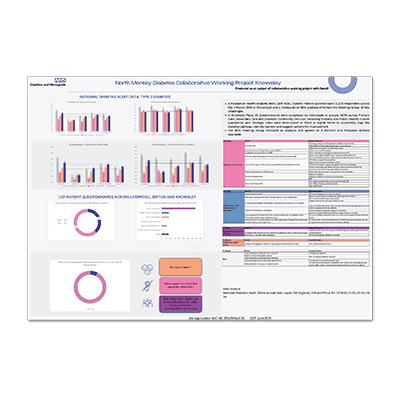
The Cheshire and Merseyside Collaborative Working Project aimed to enhance diabetes care in Liverpool, Sefton, and Knowsley. This initiative involved reviewing community diabetes services, conducting population health analysis, and mapping service pathways. The project, a collaboration between Cheshire and Merseyside ICB and Sanofi, focused on optimising care delivery and reducing variations. Key findings included significant service variations, identified areas for improvement, and proposed solutions. Outcomes included improved patient care pathways, reduced waiting times, and better treatment options. The project recommended standardised data analysis, stakeholder collaboration, and future metrics for cost-effectiveness. Next steps involve implementing actions and strategic planning.
Judges’ comments:
This entry was a good example of a collaborative approach to highlight variation and inconsistencies with an excellent use of feedback to shape and adapt services going forward. Strong outcomes were achieved such as increased completion of care processes, increased attainment of treatment targets and reduced waiting times. Very positive use of infographics and well-described feedback collection.
Finalist
Implementation of a Dedicated Inpatient Podiatry Service for People with Acute Diabetic Foot Disease
by Cwm Taf Morgannwg UHB
Executive Summary
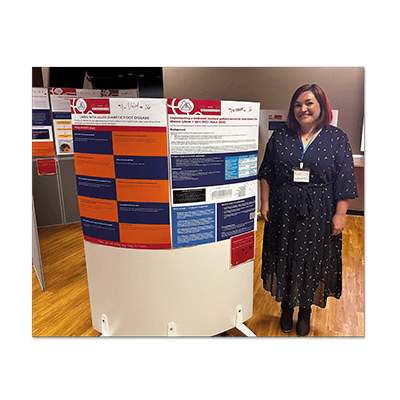
This project looks at the implementation and outcomes of an inpatient diabetic foot podiatry service at the Royal Glamorgan Hospital (RGH) between April 2023 to August 2024. The project is designed to improve patient care by establishing a dedicated multidisciplinary foot service (MDFS) within the inpatient setting with a focus on providing timely podiatry interventions, multidisciplinary coordination and education for healthcare professionals to ensure comprehensive management of active diabetic foot disease. The primary goal was to reduce length of hospital stay, enhance patient outcomes for diabetic patients presenting with foot ulcers which is a significant cause of morbidity and mortality
Judges’ comments:
This submission took an excellent approach to an existing problem. The impact to patients and the health service in terms of reduced length of stay, and therefore gains, in terms of financial and clinical time is enviable. This initiative has presented very positive outcomes data and has outlined the project’s sustainability and efficiency. A valued service where current resources are limited, showing excellent outcomes. It was great to see the MDT support and the potential to spread this across other wards and health boards.
Finalist
Enhancing Diabetes Care with a Group Education Model for People Living with Type 2 Diabetes Using Injectable Therapy
by Homewell Practice

Executive Summary
The Homewell Diabetes Injectable Groups Project aimed to enhance care for patients with T2DM on injectable therapies in a deprived Hampshire area. Monthly group sessions encouraged peer learning and covered topics like insulin use, diet, and complication management. Attendance was modest (15 participants), but feedback showed high satisfaction and improved understanding. Those attending more frequently saw greater reductions in HBA1C levels. However, challenges included low turnout and barriers linked to mental health and social care needs. The project suggests a hybrid approach, combining group and individual sessions, may better support this high-need population. Further research into engagement strategies is recommended.
Judges’ comments:
This entry from Homewell Practice was a group education programme for those on injectables. A strong initiative to reach out to those who are currently disadvantaged. The concept of group education has shown that using this format to address inequality of care and creating access to education can improve outcomes and be spread through the PCN. This is certainly sustainable in the long run and has improved care for the subset of individuals with type 2 diabetes in terms of moving care closer to home.