WINNER
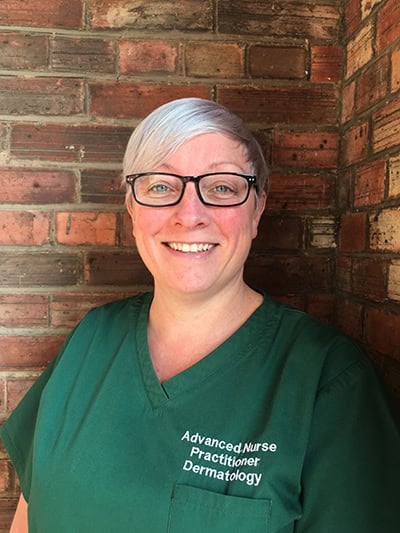
Nicola Housam
Advanced Nurse Practitioner, Dermatology, United Lincolnshire Hospitals NHS Trust
Nicola deserves recognition for her contribution to dermatology nursing over the last 13 years and brings a wealth of life and work experience to her role.
With a young family, her health care career began as a pharmacy technician in the community and after several years she decided a career change was needed. Coming from 5 generations of nurses and policemen, luckily for us she chose nursing, commencing her training at Nottingham University in 2004 and during her training appeared on the front cover of Nursing Times as they looked at the history of her 5 generations of nursing. She Graduated in 2007 with an advanced diploma and worked in intensive care initially and then moved to community and practice nursing for 6 years, completing her degree and nurse prescribing V150. This theoretical and experiential knowledge provided the foundations when another move was made, to a clinical role, dermatology role. How lucky were we.
Over the last 13 years she has she has gained MSc Advanced Nursing Practice and Masters Module Paediatric Dermatology and is now an Advanced Nurse Practitioner. Nicola has been at the forefront and focused on developing her practice and that of others, with her work on Bleach Baths in for patients with Atopic Dermatitis, which is now embedded in practice and reduces the need for antibiotics in these patients. And more recently her research relating to fire safety and emollients has been an important milestone in her dermatology nursing career. Having seen reports of fatalities and a study in the Fire Safety Journal, it provided Nicola with many unanswered questions, and a desire to improve fire safety awareness locally and more widely. It did help to be married to a Fireman, use your contacts!
“What do you get when you cross a firefighter (Nicola’s Husband) and dermatology nurse?” An interesting conversation over dinner about emollients and the fire risk to patients. Since 2010, at least 60 UK recorded fire deaths have been linked to emollient use with the victims predominantly being elderly smokers with reduced mobility. The few published studies had focused on laboratory studies only with cotton bedding, with no studies looking at the frequently used dressings in dermatology. Although there was MHRA guidance, awareness was limited in practice, commissioning and the ongoing promotion of low paraffin-based products as a safe option which was also replicated in national research demonstrating incorrect advice and absence of warnings in Fire, & Rescue Services (FRS), CCGs (Clinical Commissioning Groups) websites and formularies. With fire investigators having a poor knowledge of the importance of emollients for dermatology patients. As firefighters like setting fire to things (as well as extinguishing fires) and dermatology nurses like to apply emollients, Nicola put the two together undertaking further research in collaboration with the fire service and a team from Leicester University. The aim of the project was to examine the fire risks of commonly prescribed emollients used with viscose bandages.
Nicola coordinated the multidisciplinary team to investigate the risks of prescribed garments contaminated with different emollients, which included NHS, Fire and Rescue Services (FRS), National Fire Chiefs Council (NFCC), community fire safety advocates and local authorities. She provided teaching on emollients and why patients require emollients. The NFCC presented data and examples of fire investigations into fatalities with emollients being a factor. Community fire safety advocates presented their role for these high-risk patients in the community. Everyone was able to watch the experiments. Routinely prescribed viscose garments were chosen, with six emollients including; paraffin-based ointment/cream/lotion, and paraffin free cream/ointment, and 100% petroleum jelly. In preparation, the emollient was applied to the skin with the viscose garments worn on top overnight. The method was repeated with these samples prepared and washed as per manufactures instructions at 60c. Each garment was ignited with a naked flame which represented an identified ignition source in the home (candlelight), testing in a fire-ground setting (not laboratory), to simulate a more realistic scenario and videoed. Time to ignition and burn time was recorded. The study demonstrated a quicker ignition time and increasing burn time for viscose bandages contaminated with emollients of any type.
To summarise Nicola is an outstanding dermatology nurse who always maximises her expertise, skills, leadership and personal qualities for the benefit of patients and the continuing development and professionalisation of the speciality of dermatology nursing. This is clearly evident in her passion to ensure the safety of our patients when using emollients, which are the mainstay of dermatology treatment regimens. A true advocate for patient safety and influencing practice at a national level.