Summary
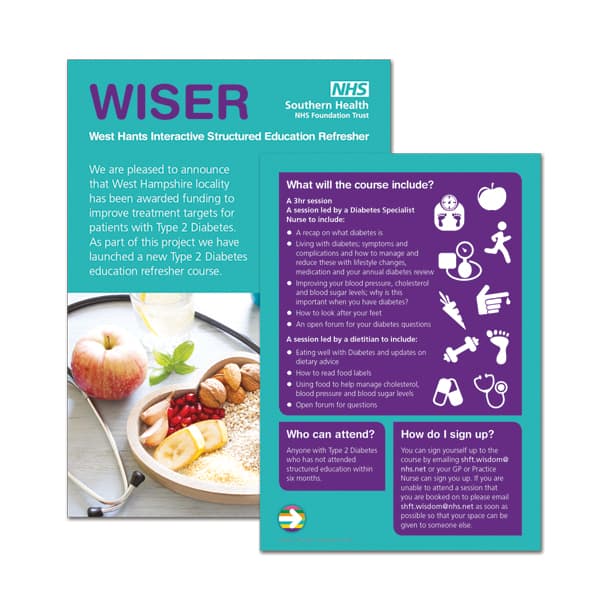
West Hampshire Community Diabetes Service received Diabetes Transformation funding to improve outcomes for people living with diabetes (blood pressure, cholesterol and HbA1c). A primary care cluster model called WISDOM (West Hants Improving Shared Diabetes Outcome Measures) was designed, with quarterly meetings to target patients requiring treatment escalation. To support WISDOM, a new group education session called WISER (West Hants Interactive Structured Education Refresher), was introduced for Type 2 diabetes patients. The goal was to offer education to people who had not had access to education in the past or who were not achieving their treatment targets.
The programme provided clear information about diabetes as a cardiovascular disease with particular focus on linking blood pressure, cholesterol and HbA1c. Help to make sustainable lifestyle changes and medication concordance were included.
Innovation
There was a clear gap in service provision for people living with Type 2 Diabetes who had been diagnosed over a year and many people who attended the course have never received any education before. A three-hour session was deemed long enough to provide the key information, activities and group discussion, and helped accessibility for those who might struggle to attend a full-day course. The group teaching style included visual, auditory and kinaesthetic teaching methods for adults, in an informal and encouraging setting. Teaching resources were assessed by patients and included Diabetes UK and British Heart Foundation informative video clips, power point slides and the use of models, including foot and HbA1c, to explain points. WISER is clear that Type 2 diabetes is a cardiovascular disease and emphasises blood pressure, cholesterol and blood glucose targets with lifestyle changes and medication in order to lower cardiovascular risk. There is a focus on looking after feet and recognising problems, which was developed with a podiatrist. The psychology element of WISER means that well-explained information is backed up with an understanding of how to apply it to real lifestyle changes. As part of the wider WISDOM project, WISER uses motivational interviewing to encourage patients to speak openly and focuses on a positive approach. This bridges the gap between clinical diabetes appointments and patient education.
Results
A sample group of 27 participants gave permission for their HbA1c level up to three months after attending WISER to be compared to their starting HbA1c up to three months before the course. This showed a 63% improvement. There was an average reduction of 6mmol/mol. Over a period of 14 months >600 people attended the sessions across West Hampshire. Numbers attending sessions have increased from approximately five per session to 10-15 per session. Evaluations showed that 97.8% rated the course as ‘very good’ and ‘good’, with >80% stating they knew how to manage their diabetes by end of the course. PAM scores from 37 responses to the three-month follow up after the session showed 22 people had improved their score. Of 14 people who had a starting level <2, nine improved their level by at least one. WISER improved both knowledge and understanding and, importantly, PAM levels and therefore motivation to manage diabetes.
Dissemination and Sustainability
WISER has been recommissioned as part of the service agreement for West Hampshire Community Diabetes Service for 2020. The CCG has recognised the need for WISER since the beginning of the WISDOM project to fill the gap in education for many people living with Type 2 diabetes. North Hampshire CCG has commissioned WISER. New staff have been recruited to teach WISER in that area and the same training programme and competencies will be used to ensure consistency of teaching in Type 2 diabetes refresher education. Other localities are also interested in rolling out WISER. Outcomes were presented as a poster at the Diabetes UK professional conference 2019 and shared at the Primary Care Diabetes Society Professional Conference 2018. One participant has agreed to be filmed by NHS England.
Method
The WISER curriculum covers three areas: diabetes as a cardiovascular disease, developed by a Diabetes Specialist Nurse and delivered by a diabetes educator; dietetics: run by a dietitian (dual trained in psychotherapy), and lifestyle change. Participants are invited to ask questions at the start and the session is tailored accordingly. The risk to cardiovascular health is emphasised and attention paid to key markers, blood pressure, and cholesterol as well as blood glucose. Diabetes is presented as a self-managed condition and empowers participants to manage their condition through food, activity and self-care, with links to support networks. Participants are encouraged to take a partnership approach with HCPs and have open conversations about options. Dietetics information includes information and messages about different food groups and the effects of foods on blood glucose control, blood pressure and cholesterol. Up-to-date dietary guidance is included, including how to aid remission, and specific diet plans are available. This interactive session uses a large food plate and food models to encourage discussion. The psychology section is taught by a qualified psychologist and focuses on lifestyle change to support self-management of diabetes. It uses cognitive behavioural therapy (CBT) methods and a tool to guide behaviour change. Psychological resources and local exercise and support groups are highlighted. Questionnaires before and after the session assess course satisfaction, including elements such as location/time of course/accessibility and communication, plus patients’ understanding about their condition, including blood pressure, cholesterol and HbA1c. A patient activation measure tool (PAM) was used on a sample of WISER participants to assess their pre- and three-month-post-course scores for confidence and empowerment to manage diabetes.