Summary
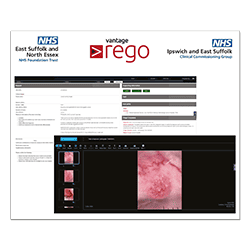
In April 2020, Ipswich and East Suffolk CCG commissioned Vantage’s Rego Teledermatology system to provide an innovative technological solution for supporting faster diagnosis and management of skin lesions and reducing unnecessary referrals to secondary care, both during the COVID-19 pandemic and afterwards. The system enables consultant dermatologists at Ipswich Hospital to triage patients and provide rapid advice and guidance to general practice by utilising static digital images to assess the skin condition without the patient being physically present. Since going live in June 2020, over 880 advice and guidance requests have been sent through Rego and 46% of cases have been managed in primary care, providing faster diagnosis, and avoiding long waits and uncertainty for patients. Over 100 patients, who would otherwise have been waiting many weeks to be seen in a routine clinic, have been fast-tracked into a two week wait (2WW) appointment for faster cancer diagnosis and treatment. A strong collaborative approach between primary and secondary care has been important to the project’s success. The team is continuing to work together to develop a Teledermatology 2WW pathway, which will enable suspected cancer referrals to be triaged and managed more effectively.
Method
Weekly project meetings were arranged with key stakeholders to monitor progress. Lead clinicians were fully engaged from the outset. A strong collaborative approach between primary and secondary care and ongoing commitment from all parties was vital to the project’s success. A practice briefing was circulated to primary care in May 2020 to introduce the new service before Rego was installed in each practice. Engagement was also carried out with hospital staff prior to deployment and training. Following installation, testing was carried out to ensure a seamless process before going live. Further communications were circulated to primary care in June 2020 to officially launch the service and practice staff, including GPs and medical secretaries, were invited to attend training sessions on MS Teams. Usage was further maximised by promoting the service at primary care forums, including practice manager and medical secretary meetings, as well as providing regular updates in the local primary care bulletin. A dashboard was developed to measure outcomes. These included the number of advice and guidance requests received by month and by practice, triage outcome and turnaround time. Data were collected to evaluate the impact on the number of routine and 2WW dermatology referrals received, and waiting times. User feedback was collated on a quarterly basis and reviewed at contract meetings, alongside overall performance and outcomes.
Results
Rego proved effective in providing rapid advice and guidance to primary care for patients with skin lesions, enabling more timely treatment for those who needed it, with care closer to home, if appropriate. By reducing unnecessary outpatient appointments, it enabled the dermatology service to run more efficiently and helped to reduce waiting times for patients who needed a hospital appointment. The Rego reporting dashboard and Ipswich Hospital data found: over 880 routine advice and guidance requests for skin lesions had been received from GP practices through Rego since June 2020; 85% of requests received a response from the consultant dermatologist within three working days; 46% of patients were given advice and guidance to be managed in primary care, saving over 400 outpatient appointments and helping to reduce footfall; 40% of patients required a routine hospital appointment; 14% of patients were fast-tracked into a 2WW appointment, supporting faster skin cancer diagnosis; waiting times for routine dermatology outpatient appointments were reduced from 28 weeks (Feb 2020) to 17.5 weeks (December 2020). A user feedback survey found that all respondents agreed that the system had improved access to care for patients with skin lesions during COVID-19; 95% of them were pleased with the response time and quality of advice and guidance, and 78% felt that the system supported earlier detection and intervention of previously undetected cancerous lesions.
Sustainability and Spread
The ongoing revenue cost for 2021/22 to maintain the service will be taken from existing budgets to evaluate the impact the pathway redesign has had on the system. This will be further supported by the development and ongoing investment in the Cancer Rapid Diagnostic Service. In February 2021, the CCG was successful in a bid to roll out Rego in North East Essex, which will provide parity of systems across the East Suffolk and North Essex NHS Foundation Trust (ESNEFT) hospital sites. Implementation of the system was scheduled to be completed by the end of April 2021. Alongside this, options for an integrated care system (ICS) approach to teledermatology beyond April 2022 are being considered. A virtual dermatology event is planned, following the sessions run at a regional and national level, inviting stakeholders within the ICS, including GPs, consultant dermatologists, nurse specialists, patient representatives, regional leads and providers. Learning from local and national pilots will be shared and plans developed to build on the success of current initiatives. This will promote the opportunity to network within the system and ensure a standard approach for patients. This work was showcased at a GP education event in March 2021, attended by over 250 staff. The effectiveness of the service is under constant review and ongoing support is provided as required. Outcomes of ICS-commissioned Healthwatch work exploring digital literacy in the local population will be used to evaluate health inequalities in relation to teledermatology.