Summary
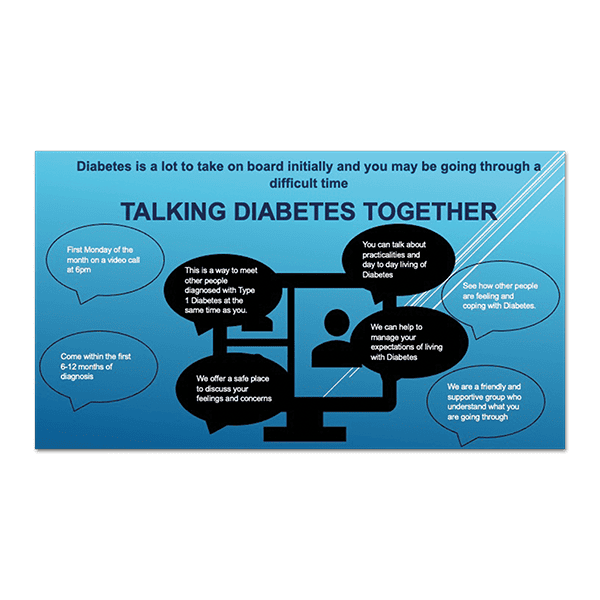
People newly diagnosed with type 1 diabetes (T1D) can feel overwhelmed, alone and find it difficult to cope. They may find education difficult to take on board and need support from healthcare professionals, creating multiple appointments and demands on time. This initiative aims to support people newly diagnosed with T1D within Swansea Bay University Health Board. It provides an opportunity to come together to attend a virtual, monthly support group to discuss living with diabetes to promote self management. People can discuss their emotions, frustrations and how to deal with diabetes day to day.
Innovation
A quarter of people with T1D have diabetes distress, which may occur at, or soon after, diagnosis. If not addressed, it can lead to depression and impact outcomes. Support groups offer a safe space for people to share their experiences and emotions. Those who attend the group are diagnosed at a similar time. They can offload the burden that they feel and take control of diabetes from the start. A dietitian who supports people soon after diagnosis realised that people need to talk to each other to create positivity in the future and set about establishing a group. The main challenges were around facilitating discussion, managing expectations and emotions. It was also important to create a safe and welcoming experience. An initial group supported people who were diagnosed at the same time, some of whom were distressed and unable to take their own insulin because of needle phobia. They needed to talk to someone in the same position as themselves, to share their experiences to help each other. Each person was asked if they would like to speak to someone else about their diagnosis and all showed an interest in further support. The team psychologist provided guidance on setting objectives, as the aim of the group was more of a counselling/supportive role, not a dietetic one. The dietitian accessed psychology training for further information. Ground rules on confidentiality and patient safety were set and the group moved to an evening to support greater attendance. Benchmarking with colleagues across Wales showed that there were no groups of this nature running in Wales. It differs from usual support groups as it encourages people to attend together at diagnosis. Topics of concern, such as insulin injections, are unique to the type 1 diagnosis so people can talk to others in the same situation.
Equality, Diversity and Variation
The health board has three hospital sites with three diabetes units. People diagnosed across all the units have been offered access to the group, ensuring an equitable service. The group is run virtually to reduce travel and facilitate attendance. As attendees are in their own homes, they are more likely to be relaxed, creating a safe space for people to express their feelings and concerns. A group setting is a problem for people with language barriers, but they can be offered translation or family/friend support to engage. The Nutrition and Dietetic Service supports people to access digital platforms and encourages anyone without access to use the family’s internet and email address to join the group. A different platform is being investigated so people do not have to download an app to join. The topics discussed are appropriate to all as the participants choose the agenda. A personcentred approach increases engagement and improves outcomes. The dietitian runs the group so there is continuity of topics discussed from one session to another.
Results
Questionnaires were completed after the first group and at six months. Initially, participants felt alone, but the group gave them confidence and support. With better mental health and coping strategies, self-management improved over the long term. The three sites now promote the group. A poster was developed advertising the group, which is discussed and given to people at diagnosis. The initiative reduced anxiety and fear about living with diabetes after diagnosis, reducing risk of diabetes distress. Evaluation forms showed that people benefited from attending and understood they were not alone. They felt that life with diabetes was more normal after attending. The people with fear of insulin injections were given reassurance and confidence and, as a result, started to take their own insulin. Funding was not required for this initiative and the group has reduced the number of individual appointments and phone calls. Long-term costs may be saved as people are empowered from the start of diagnosis to look after themselves.
User Feedback
The psychologist fully supported the group and praised the facilitator for her warm and compassionate manner. Participants were positive about their experiences and their feedback helped to develop the group. As a result, people who had had diabetes for over a year were invited to attend to discuss how they had managed. Six months was suggested as a good time period for people to attend, but this does not suit all, with 17% of people wanting longer. Now people are asked if they still want to attend after six months. Difficult topics are addressed sensitively in a relaxed atmosphere.
Dissemination and Sustainability
The project was offered to people across one health board in Wales, covering three diabetes teams. Feedback showed that people felt better able to live with diabetes by sharing experiences and emotions. Participants frequently mentioned that meeting others in the same situation was extremely helpful. Patient information booklets for managing a new diagnosis and diabetes burnout provide a good basis for discussion and these will be used more frequently in the group and as an additional point of reference to turn to outside of the group. Using the Diabetes Distress Scale prior to and after the group will be considered to demonstrate effectiveness and outcomes that matter to people. Given the positive feedback, it is important to encourage others to develop more groups. This work, and how it can be easily replicated, will be promoted across Wales with diabetes dietitians and DSN groups. The feasibility of peer support groups for parents of newly diagnosed children and teenagers, as well as teenagers themselves, is being investigated.