Summary
People with diabetes in Hampshire have access to several organisations, charities and online communities for help and support however none focus specifically on the newly diagnosed or provide a one-to-one ‘buddy’. Peer support is increasingly recognised as vital for health and wellbeing. Sugar Buddies are trained volunteers who provide support through a variety of media, enhanced by group learning and socialising. Their primary role is to support and signpost, not to provide medical advice, although all Buddies have first-hand experience of diabetes and have a health professional mentor, with a mission to prevent negative experiences and increase positive health outcomes.
Results
Feedback from people being supported by a Sugar Buddy is overwhelmingly positive and many are signing up to become Buddies themselves - there are currently 20 in the scheme. West Hampshire Community Diabetes Team within Southern Health NHS Foundation Trust have taken responsibility for governance, in particular the training and mentoring of the Buddies. Buddies are linking directly with local GP Practice diabetes teams and acute diabetes teams as well as attending Parliamentary think tanks and sitting on CCG steering groups.
Challenge
People with diabetes in Hampshire have access to several organisations, charities and online communities for help and support for their diabetes – however, none focus specifically on the newly diagnosed or provide a one-to-one ‘buddy’. Being newly diagnosed with diabetes is a life-changing event which can lead to people feeling vulnerable, confused and alone.
Objectives
Using a variety of survey methods, to assess the need for a buddy scheme for people with diabetes and the best way this could be provided. To recruit willing and suitable volunteers to be Sugar Buddies, with induction and refresher training given by the diabetes team.
Solution
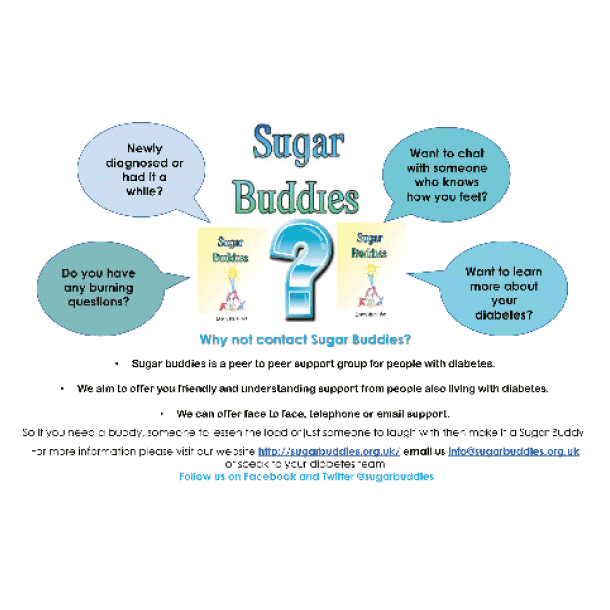
Patient focus groups were held by West Hampshire Community Diabetes Service to discuss the potential for development of a peer support scheme. A website (sugarbuddies.org.uk) was set up by a volunteer and all Buddies set up with Sugarbuddies email addresses to prevent individuals’ email addresses having to be used. Advertising posters were developed and distributed to local patient groups, libraries, GP surgeries, hospitals, retinal screening vans and Buddies have personally visited local diabetes teams to promote the scheme. There is an online presence, including Twitter and Facebook, and monthly social meetings are set up for new and old members. People with diabetes can self-refer by emailing a generic email address or be referred by their health care professional with consent from the individual. Buddies are allocated to each referral, using face-to-face or online contact. All Buddies have first-hand experience of diabetes either as patient or carer and attend an initial induction session run by the West Hampshire Community Diabetes Team on Saturday mornings which includes information about diabetes and safeguarding. Buddies do not provide medical advice but support, reassurance and signposting. They fill the gap between touchpoints with the local health services and can direct someone helping navigate the complex condition and health system.
Learnings
People with diabetes are willing to volunteer and share experiences to improve other people’s experience of living with diabetes and improve health systems serving local populations, and patients will benefit from this. However, it should be borne in mind that Sugar Buddies are volunteering time around their existing commitments of studying or working and family life – and HCPs also (if it is not a commissioned service) will need to deliver training and act as mentors in their own time or with the support of their Trust/service. Local health services and local health care networks, charities or key individuals must be involved to develop and oversee the scheme. Measuring and reporting quality outcomes is important – and self-referrals to education programmes will probably increase as a result of introducing such schemes.
Evaluation
A follow-up questionnaire and repeat patient focus groups have been used, and accredited evaluations such as the Patient Activation Measure and PAID scores before and after buddy input are in development currently.