Summary
The CCG commissioned the Cheetham Al-Hilal Community Project (AHCP) to deliver a course to meet the needs of their community, with a pilot seeing local diabetes specialists partnering with community leaders to adapt and design education courses for people with Type 2 diabetes. In all, 90% of participants were self-referrals, with just 10% from practices, reflecting the community’s success at engaging their community, and all reported that the course helped them find something they could do to better manage their diabetes. They were delivered by GP facilitators from the AHCP and community bi-lingual group workers, supported by health trainers from Manchester Mental Health & Social Care Trust and quality assured by a Diabetes Nurse Consultant (DNC).
Results
Fifty-six (90%) of the 62 people with diabetes were self-referrals, reflecting Al-Hilal’s success in promoting awareness and engaging with their community to attend. Just nine (10%) were GP referrals, all from one local practice. Participants were very enthusiastic about the course with 54 (95%) of the 57 people who completed the CM evaluation form describing it as either effective or very effective. All reported finding something that they could do to better manage their glycaemic control and diabetes and 23 (40%) people signed up for the HT’s health & wellbeing course of whom 12 (52%) attended. Facilitators and GW’s, all members of Al-Hilal, were strongly positive about the course, enjoyed delivering it, felt it worthwhile for the participants and were keen for it to continue. The results of CM data have been compared, in so far as is possible, with existing DESMOND (Diabetes Education and Self-Management for Ongoing and Newly Diagnosed) course data. These courses are different in their approach to learning, recruitment and delivery. CM has been community-led using trained GP and lay community educators all of whom are bi- or multi-lingual. CM is more flexible than DESMOND, with lower staff training and quality assurance costs resulting in a lower cost per course, and offers a greater number of places on each course making the CM cost per participant even lower still.
Challenge
Results of the National GP Survey (2012) showed that only 43% of NMCCG respondents felt they ‘received enough support’ to manage their own health compared with 53.1% for comparable CCGs and 58% for England as a whole. To address this, in 2013 NMCCG commissioned Pennine Acute Hospitals NHS Trust (PAHT) to provide a Community Diabetes Specialist Nurse (CDSN) diabetes education programme. However, early feedback from the course showed that the local BME community were under-represented and that some of those referred were rejected because they were unable to speak English sufficiently well. The CCG considered this all the more important because around 25% of their population are from the BME community, because diabetes is far more common among them and because their morbidity and mortality from diabetes is considerably higher than those of white, European origin. Cheetham Al-Hilal Community Project, a local mosque-based charity approached NMCCG to propose a diabetes education programme delivered by them to address this and meet the needs of their community. This led to a pilot that saw local diabetes specialists partnering with community leaders to adapt and deliver a structured group education course for people with Type 2 diabetes, for their community.
Objectives
The aims of this pilot were to provide equity of access to structured group Type 2 diabetes education for the underserved BME community of NMCCG, ensuring that course design and delivery was culturally sensitive and appropriate, the local community engaged with the service, and participants felt that the course helped them to better manage their diabetes and adopt a more healthy lifestyle.
Solution
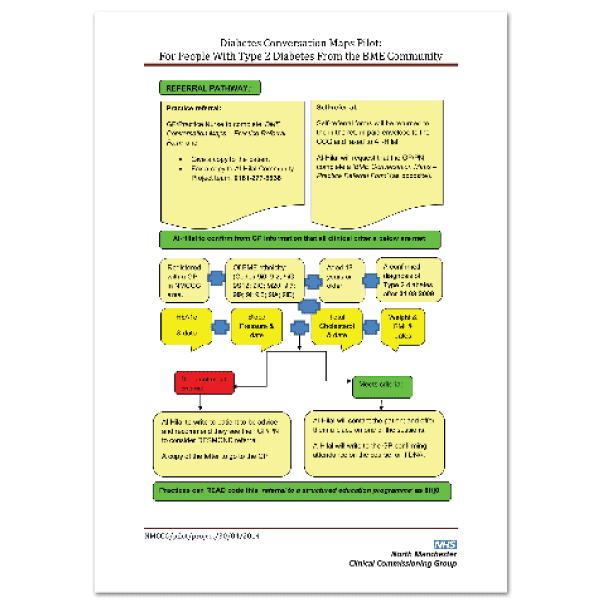
The project team chose Conversation Maps (CM), as an internationally recognised structured education offering the flexibility required. The courses were delivered by GP facilitators from the Al-Hilal community supported by local bi-lingual group workers (GWs). They were supported by health trainers (HT) from Manchester Mental Health & Social Care Trust (MHSCT) and a diabetes nurse consultant (DNC) provided quality oversight.
Learnings
Facilitators of future CM courses need to consider the cultural, linguistic and other likely time constraints for the participants they wish to reach and determine how best to deliver this. Course place costs should be calculated on a cost per participant attendance basis (circa £60) to incentivise any community led providers to operate efficiently. Courses should have as a KPI a minimum attendance rate. There is the potential for more co-operation between the teams delivering CM and DESMOND to include cross referrals where appropriate. Conversation Maps is fully compliant with NICE guidance but a single audit tool would facilitate quality assurance comparisons across all course provision.
Evaluation
The CCG commissioned an independent parallel evaluation focused on how well the programme met its objectives and to provide early insight into opportunities to improve. The analysis and evaluation of the data was undertaken by the DNC with advice and support from the local project team and national expert colleagues in the field of structured group education courses for people with Type 2 diabetes.