Summary
Three challenges had to be overcome: the pandemic necessitated changes to face-to-face and group education; the Expert meter, popular for accurate bolus calculations, was being phased out; and more Libre users wanted to use a scanned value in a bolus calculator. MyLife was identified as the most suitable bolus calculator app. The diabetes team, patients and families were educated in set-up via new training resources. IT challenges and poverty were overcome to ensure accessibility. Then ward staff were trained, to enable the initiation of MyLife at diagnosis. Learnings and training resources were shared with South West CYP Diabetes Network.
Innovation
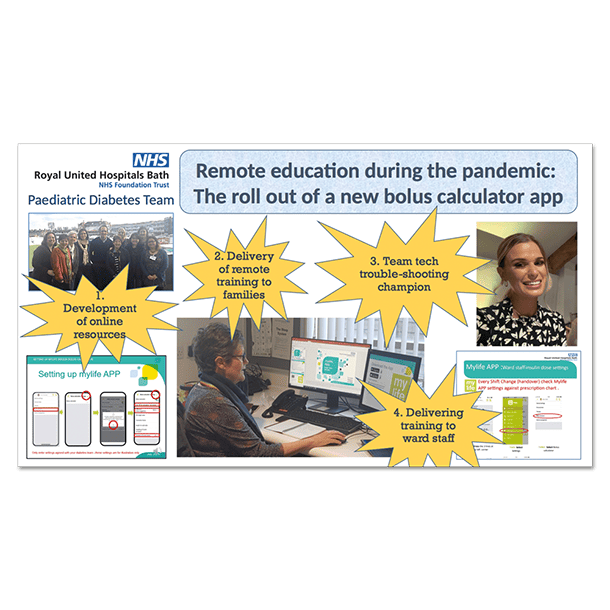
The caseload had to be moved from the Expert meter to an alternative bolus calculator. This was triggered by the phasing out of Expert meter, but was also required so that Libre users could use a scanned value in order to maintain the accuracy of their bolus calculations to achieve optimal glycaemic control. This had to be done in the context of the pandemic, embracing virtual consultation and then virtual education, and replacing group education sessions with one-to-one sessions. Once the MyLife bolus calculator app was chosen, training materials were developed that could be delivered remotely. These included: a step-by-step guide on app set up; a PowerPoint presentation that could be delivered to a family across a virtual platform; and a recorded, narrated presentation of the slides that could be re-watched. Team members offered the remote training to their caseloads individually. The training and set up were delivered to 25 children and young people before re-evaluation. Technical issues were resolved by the app developer. The training was rolled out to ward staff, so that the app could be initiated at diagnosis, and established patients using the app could be safely cared for if admitted to the children’s ward. This was done with short training sessions, delivered on the ward, over a month, with understanding evaluated with a quiz. A video explaining the new initiative and demonstrating the set up was also recorded and shared on Workplace for other staff.
Results
The caseload that needed to transfer to MyLife was 125. Between March 2020 and June 2021, 90 patients (72%) were set up. This included establishing the correct individualised bolus calculator settings, familiarity with using the app, and automatic upload to Diasend, to facilitate remote support by the diabetes team. Caseload review identified patients more resistant to change, often teenagers who had used the Expert meter for longer. Diabetes nurses put additional time into discussing the benefits with these individuals and offered flexibility in timing and delivery of sessions to facilitate their uptake. In addition to successful delivery of the training and high patient acceptance of the new bolus calculator, significant improvements in the unit HbA1c results were noted. Despite the challenges of the pandemic, and the increase in virtual consultation, more than 99% of the caseload had at least one HbA1c performed, so the 20/21 data represented the entire patient cohort. The diabetes unit key data from the 2019/20 NPDA audit period was: Median HbA1c 62.5 mmol/mol; HbA1c HbA1c > 80 = 14.6%. The equivalent figures for the 2020/21 audit data submission were: Median HbA1c - 59.5 mmol/mol; HbA1c HbA1c > 80 = 8.74%. This is as a result of: the acceptability and usability of the bolus calculator app; the increased use of a bolus calculator for patients using a Libre fl ash glucose monitor, whose use of the Expert meter bolus calculator had already reduced; and the increased visibility of patient data, with automatic upload of data to Diasend that enabled increased support and advice from the diabetes team. The improvement in HbA1c, with beneficial impact on the long-term complication rates, has significant health impacts on an individual level, and health and economic impacts on a population level. There are also cost benefits from switching to a different blood glucose testing meter.
User Feedback
The caseload that needed to transfer to MyLife was 125. Between March 2020 and June 2021, 90 patients (72%) were set up. This included establishing the correct individualised bolus calculator settings, familiarity with using the app, and automatic upload to Diasend, to facilitate remote support by the diabetes team. Caseload review identified patients more resistant to change, often teenagers who had used the Expert meter for longer. Diabetes nurses put additional time into discussing the benefits with these individuals and offered flexibility in timing and delivery of sessions to facilitate their uptake. In addition to successful delivery of the training and high patient acceptance of the new bolus calculator, significant improvements in the unit HbA1c results were noted. Despite the challenges of the pandemic, and the increase in virtual consultation, more than 99% of the caseload had at least one HbA1c performed, so the 20/21 data represented the entire patient cohort. The diabetes unit key data from the 2019/20 NPDA audit period was: Median HbA1c 62.5 mmol/mol; HbA1c HbA1c > 80 = 14.6%. The equivalent figures for the 2020/21 audit data submission were: Median HbA1c - 59.5 mmol/mol; HbA1c HbA1c > 80 = 8.74%. This is as a result of: the acceptability and usability of the bolus calculator app; the increased use of a bolus calculator for patients using a Libre flash glucose monitor, whose use of the Expert meter bolus calculator had already reduced; and the increased visibility of patient data, with automatic upload of data to Diasend that enabled increased support and advice from the diabetes team. The improvement in HbA1c, with beneficial impact on the long-term complication rates, has significant health impacts on an individual level, and health and economic impacts on a population level. There are also cost benefits from switching to a different blood glucose testing meter.
Dissemination and Sustainability
The pandemic necessitated the production of education materials in a different format, which increased consistency in the messages and training delivery, reduced stress, and proved an efficient delivery method. Time saved was spent tailoring training delivery to those families with access difficulties. The experience and training materials were shared with other paediatric diabetes units in the South West, through a presentation and Q&A session at a network meeting in March 2021. Other Paediatric Diabetes Networks showed interest. The transition service has raised awareness of the bolus calculator and training materials with the local young adult diabetes service.