Summary
NWS has been working with the Asian community in Woking to provide education about the prevention and self-management of diabetes. Delivered by a multi-disciplinary team, the project required developing relationships with local religious leaders and the community. Its elements include a tailored education programme, specific to the needs of the Asian community and delivered in a variety of languages. The team also visited three mosques in the lead up to Ramadan to give talks about the management of diabetes during fasting and has been supporting the take-up of NHS Health Checks to ensure the community are aware of the opportunity to receive a free check and the benefits of doing so. The group has attended local community events and offered bilingual brief advice on health interventions.
Results
Initial feedback from the first two Ramadan Diabetes talks has been extremely positive with 88% agreeing that the talk did help manage their health, their diabetes or diabetes in their family - and 88% (n=38) agreeing that the talk has helped them to make healthier food choices. Imam Hafiz Muhammed Saeed from the Shah Jahan mosque also provided a reference for this application. Feedback will also be gathered from local GP practices in July to understand if the information supplied was helpful.
The impact on people in this community with diabetes or with a family member who has the condition will be long lasting as they will be able to take the key messages away with them and use it to better manage their health. It is envisaged that the messages will also be spread within the community wider than those who attended the Shifa Diabetes programme or the Ramadan talks.
Challenge
Type 2 diabetes is up to six times more common in people of South Asian descent, and in the UK, people of South Asian origin (of Indian, Pakistani and Bangladeshi descent) are the largest ethnic minority who now comprise the majority ethnic group in several urban locations. Woking, a borough within North West Surrey, has a high Black Minority Ethnic (BME) community which makes up 8.7% of the total population. In NWS the X-PERT Diabetes Programme is offered to patients with diabetes and has been delivered to the Asian community in the past, where it has been found inappropriate, resulting in a high dropout rate and inconsistent attendance.
Objectives
To improve engagement and education among this community, a patient diabetes education programme called Shifa Diabetes has been developed by a diabetes specialist nurse and a health link worker who works with BME communities and speaks seven languages. The aims are: to increase awareness and identification of diabetes, the risk factors, prevention and management of this condition among the Asian community in NWS; to improve the knowledge and understanding of diabetes management and the implications of fasting; to develop and appropriately deliver simple and clear messages, resources and education which are specific to the cultural needs of the Asian community.
Solution
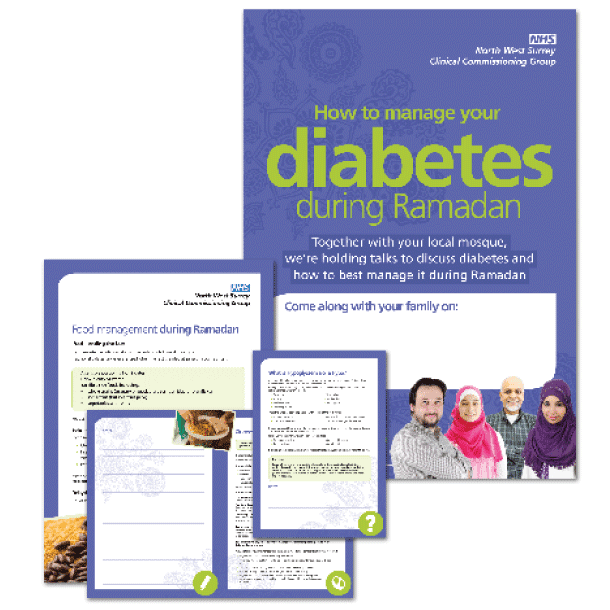
The team developed a NWS Public Health Diabetes Group to oversee the implementation of the Shifa Diabetes programme, which developed and piloted in the Woking area. A business case was taken to the NWS CCG Strategic Change Board to request funding for further roll out and funding was identified for the Ramadan Diabetes project and a project plan was developed. Engagement was undertaken with the imams in the Woking mosques and communication was developed. A poster and information leaflet was developed by the team including taking pictures of Asian foods and a health professional education event was designed by the diabetes team on how to advice patients with diabetes who wish to fast for Ramadan. Support was identified and provided by Janssen and the event was advertised across the locality.
Learnings
Each element has required evaluation and adaptation in order to ensure it meets the needs of the audience. Specifically, the learning from the first Ramadan Diabetes talk was to do it before prayer and to have a display stand outside the mosque to promote it. The team was also mindful that the medication element of the talk was only useful for those who have diabetes and that they needed to be careful not to ask the audience questions which would mean that, in answering the questions, the individual would disclose that they are have diabetes. Continuous reflection on the material and delivery of this project has enabled the team to provide the best possible support to this community.