Summary
An educational toolkit was developed to support healthcare professionals in assessing and managing radiotherapy-induced skin reactions. These unwanted effects can range from mild erythema to confluent moist desquamation – and may affect 85-90 per cent of patients in a moderate to severe form.
Correctly assessing and managing these skin reactions increases patient comfort, treatment compliance and offers an enhanced quality of life. The toolkit offers a knowledge base and practical guidance for all healthcare professionals, with and without specialist knowledge, in a variety of healthcare settings. It can be used as a framework to inform local guidelines, and has also been implemented in national and international centres.
It is available as a printed booklet, an e-document and a ‘web app’. There have been over 1,100 electronic downloads from the Yorkshire Cancer Network website and requests for copies from around the world.
Challenge
Radiotherapy can cause a range of side effects, one of the most common being a skin reaction, ranging from mild erythema to confluent moist desquamation, a debilitating symptom often associated with a decreased quality of life. Approximately 85-90 per cent of those receiving radical radiotherapy will experience a moderate to severe skin reaction.
The care of radiotherapy patients involves specialist health professionals but frequently also includes primary care staff, many of whom will have little or no knowledge of the effect of radiotherapy on tissue viability, and the management of radiation induced reactions. Inappropriate dressings frequently cause further damage to the skin. The severity of these skin reactions can peak around 7-10 days after treatment, when primary care staff have the lead role.
A common misconception is that radiation induced skin reactions are burns and understanding the difference between burns and skin reactions is essential for correct assessment and management. ‘Burn’ implies an accidental occurrence but acute and delayed skin reactions are a known side effect. Also, a lack of knowledge about confluent moist desquamation leads to inappropriate prescribing of antibiotics when the area is perceived to be infected.
Disseminating knowledge and skills was difficult. Educational sessions and clinical workshops were unsuccessful as staff shortages resulted in poor uptake and cancellations. A more innovative and resourceful way of delivering education and training was needed, particularly outside of specialist centres.
Objectives
To develop an educational resource for the management of radiotherapy induced skin reactions in the form of a toolkit that was user-friendly, appropriate for a multi-professional audience, applicable in a variety of settings and adaptable to local needs.
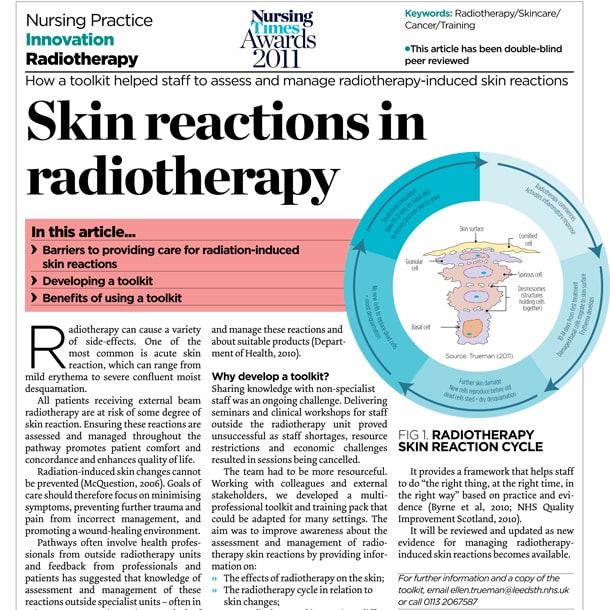
The toolkit would include information on the effect of radiotherapy on skin cells; how a skin reaction develops and the cycle of changes; factors that can affect and exacerbate a reaction; how a skin reaction differs from a burn; the goals of care; an assessment framework; treatment options and rationale for interventions; appropriate product selection; a self assessment test; and a CD ROM containing an electronic version and downloadable PDF files of the materials.
We wanted the toolkit to increase awareness of radiotherapy induced skin reactions and thereby improve patient care and treatment. This was to be achieved through a practical framework to guide clinical practice in a systematic way, ensuring that assessment and management are consistent, effective and safe. It would also be cost-effective by ensuring that only suitable wound care products were used.
Solution
Leeds’ existing radiotherapy skin care guidelines provided the template for a clinical guide that would, at a glance, summarise how to manage radiotherapy induced skin reactions. A joint working initiative with key healthcare partners formatted the information into a more comprehensive resource that was printed in the form of a toolkit. A small pilot study (around 25 nurses from a variety of non-specialist settings) provided positive feedback, including the comments: ‘An excellent resource – easy to understand, logical, pitched at the correct level,’ and: ‘It is a great resource and educational tool – I would feel confident following this knowing that I was doing the right thing, at the right time.’
After this, the toolkit was officially released and disseminated by a range of methods including in-house mandatory training sessions; inclusion on the Yorkshire Cancer Network website; publication of a toolkit article in a national nursing journal; presentation at a conference and regional study days; fulfilling requests for copies both at home and overseas; and supporting educational material for healthcare partners to use in product training.
The toolkit is suitable for all levels of healthcare professionals in a mixture of settings. It can be adapted to inform local guidelines and is available as a printed booklet, an e-document and a ‘web app’.
Results
Evaluation has been by a number of measures including: the number of downloads and requests; patient feedback; a decrease in the number of post-treatment enquiries from primary care staff; the toolkit being adapted as a framework to inform local guidelines (including internationally recognised cancer centres in the UK); requests to present the toolkit at study days/training workshops in hospitals and primary care settings; and positive feedback from colleagues.
There have been no reports of adverse events or clinical incidents linked to the toolkit. It has improved understanding of radiotherapy and related skin reactions at the St James’s Institute of Oncology, demonstrated by the reduced number of calls for out-patient radiotherapy nurses to see patients on the wards. They still make visits to the wards but use the toolkit for on the job training of hospital based nurses. Parts of the toolkit have been incorporated into the Trust’s ‘Radiotherapy Induced Skin Reaction’ care plan, reinforcing knowledge and skills and a ‘web app’ version for use on mobile devices is being piloted.
Evaluation
This resource was created to meet a local need but its unexpected success and consequent global dissemination has left the team to complete a comprehensive audit and evaluation.
Disseminating this toolkit has maximised its impact on patient care by closing the gaps between different healthcare settings and varying clinical practice. Several renowned cancer centres in the UK are using it to inform local guidelines, clinical practice and education programmes (including the Royal Marsden and Christie hospitals). Educational grants and award scholarships have covered the costs of the toolkit, which have been minimal, and involved posting out hard copies and developing the web app.
If current global interest continues to grow it is anticipated the toolkit will disseminate to less well-developed countries where it can help advance and update clinical practice using evidence based principles.
This toolkit has provided a simple, easy to use guide that benefits patients and healthcare professionals. It improves care and outcomes, enhances the patient experience and protects them from avoidable harm. For healthcare professionals it increases knowledge, expands skills and improves competence.
Impact
The toolkit is delivered within the Trust’s oncology mandatory training programme, reaching large numbers of practitioners in a systematic and consistent way. It has been presented at key conferences, reaching a diverse range of healthcare professionals and stimulating further discussions, networking and requests for additional presentations in related settings. It is adaptable, easy to replicate and its principles can be easily absorbed into local guidelines and practice. It has been adopted and adapted by national and international cancer centres and this ‘domino’ effect appears to have greatly raised the awareness of this specialist area of cancer care.
The toolkit has been disseminated globally and has the potential to influence international standards and guidelines. It also has the potential to become an income generating product with further development in the ‘app’ arena.