Summary
Developed from the existing specialist palliative care team, to encompass the acute oncology service and subsequently the cancer of unknown primary service, the integrated cancer care team at Basildon Hospital strives to provide a personalised, effective and responsive service that puts patients at the heart of decision-making. The service provides seven-day face-to-face contact and assessment for patients, wherever they are in the hospital, supporting them to receive the right care in the right place and in a timely manner.
Challenge
The National Chemotherapy Advisory group specified in 2009 that all hospitals with an emergency department should provide an acute oncology assessment service. In 2010, the trust piloted an acute oncology service, resourced by nurse specialists within palliative care. A substantive Acute Oncology Service was launced in 2012.
In England and Wales over 10,000 cases of cancer of unknown primary (CUP) occur annually. It is the fourth most common cause of cancer death, but 2010 NICE guidelines identified a lack of specialist nurses.
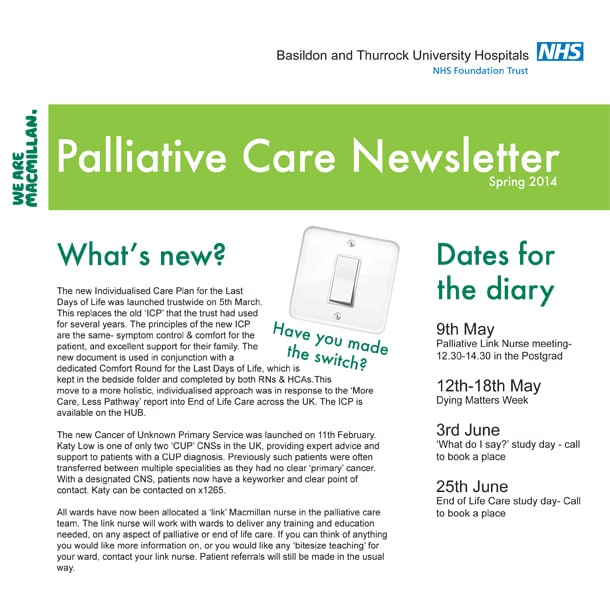
A CUP service was established at Basildon Hospital in 2013. The trust identified the need to financially invest in a Clinical Nurse Specialist. A CUP CNS started in October 2013, based in the Specialist Palliative Care Team.
Objectives
The team aimed to improve patient experience and pathways by working between both primary and secondary care and across divisions and specialities.
By embedding the AO service and the CUP service within the specialist palliative care team, AO admissions gained access to immediate specialist pallaitive care input. Having a CUP CNS within the specialist palliative care team gave patients direct access to specialist palliative care advice.
Both the AO service and specialist palliative care team provide seven-day cover. They weekend cross-cover for the CUP service, guaranteeing prompt holistic patient assessment.
Ensuring staff across the trust are aware of the integrated cancer team, and the support and advice it provides across seven days, will increase accessibility to the team’s specialist services.
Solution
The Cancer Of Unknown Primary Service was officially launched in February 2014. In June that year, the AO and CUP nurses were officially adopted by Macmillan Cancer Support.
An audit of the AOS in May 2014 highlighted that 35 per cent of AOS-assessed patients also received specialist palliative care input during their assessment. This demonstrated the benefit of running AOS and palliative care within an integrated team.
An analysis of CNS patient contact over six monthz revealed that 457 patient assessments and reviews were carried out at weekends, due to the integrated cancer team providing seven-day cross cover.
A March 2014 user survey found that staff across the trust were aware of the team providing seven-day support and advice.
Results
Learnings
A key challenge in the development and implementation of the Integrated Cancer Team was providing education and awareness to staff across the trust, particulary as this is not a treating cancer centre.
The team provided a robust education and teaching programme. This is a rolling programme covering various aspects of acute oncology, specialist palliative care and the role of the Integrated Cancer Team.
Although raising awareness and providing regular teaching sessions was both time consuming and labour intensive, the team felt they reaped the rewards. These included the CQC rating end of life care across the trust as good, and describing the team as ‘outstanding’.
Evaluation
The Integrated Cancer Team had a significant impact on patient care and experience. The high proportion of patients seen by both the Acute Oncology Service and Specialist Palliative Care Team reflects the need for seven-day cross cover in these specialities.
The BTUH Integrated Cancer Team felt that this could act as a model for other district general hospitals without an oncology department on site. Pooling existing resources (acute oncology, specialist palliative care and cancer of unknown primary) provides a cost-effective approach to delivering a co-ordinated service to cancer patients.