Summary
The team developed a culture of equality and reciprocity with its users (co-production) and a series of co-design sessions provided patients with the opportunity to construct a vision of their ideal service. Recurring themes included a venue that is more conducive to learning; hands-on support when carrying out calculations of carbohydrate content during actual food preparation and service; the involvement of other family members and several other agencies involved in the child’s care; and a greater time allocation for appointments. Through the training of schoolteachers, teaching assistants, catering staff – as well as parents and siblings, or foster carers, social workers and young person practitioners – a solid foundation is laid down for the seamless management of this chronic, lifelong condition.
Results
In January 2014, Hba1c outcomes improved from an average of 76 mmol to an average HbA1c of 72 Mmol/mol and further improvement of this in May 2015 to 67 Mmol/Mol. There was also an improvement in the proportion of patients with an HbA1c < 58 Mmol/mol: in Jan 2014 23 patients out of 98 patients - a rise to 23.4% - and in May 2015 a further rise to 35 patients out of a countable patient group of 104 patients which is 33.6%. Improving proportion of patients with an HbA1c of > 75 Mmol/mol: in January 2014 the figure fell to 30 patients out of 98 – a fall to 30.6% and a further fall in May 2015 to 29 patients out of 104 which is 27.8%. 4.5% admission rates in the UK for Diabetes-related issues such as DKA and Hypoglycaemia versus national average around 8%. Patient DNA rates have reduced with a DNA rate of 10% inclusive of DNAs from all community appointments and paediatric outpatients.
Challenge
In June 2012 the team decided to change the way in which paediatric diabetes care was delivered to patients and their families. Since 2004 it has operated in the community with home visits alongside clinic visits every three months, but there were a high percentage of patients with a high HbA1c and a lot of DNAs to the paediatric diabetes clinics with only 9 patients (11.8%) out of 76 countable patients achieving a HbA1c of <58 Mmol/mol and 35 patients out of the 76 (46%) with a HbA1c of >75 Mmol/mol. The overall average HbA1c of all our patients was 76Mmol/mol.
Objectives
To provide the patient with a unique gold standard service that was built around them and their needs outside the hospital; to improve their experience and their engagement; to increase the time we were able to provide to them and place that suited them; to improve patient HbA1c levels and therefore improve their overall long term health; and to reduce DNAs.
Solution
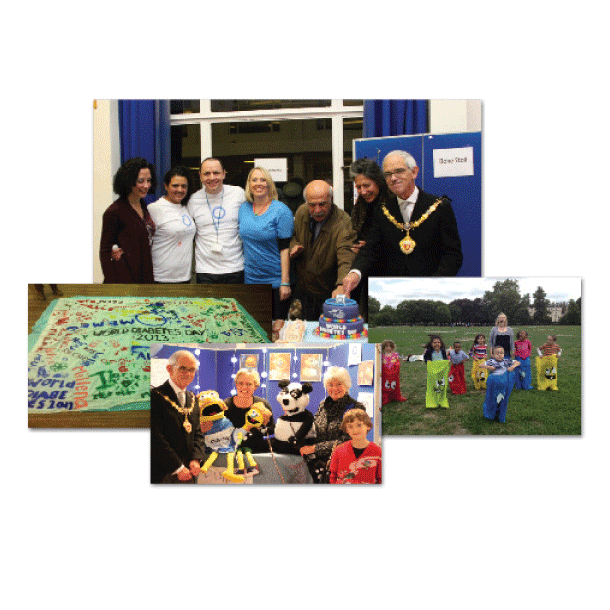
Service was increased 18 years to 19 years, giving an extra year of support when a young person is vulnerable and increasing flexibility of patient to set location from home, school, coffee shop and so on. The patient decides who supports them, the PDSN, dietitian or consultant. There is an annual review over CGM results and peer support in place. New services were designed with patients to find out what they wanted and how it should work, hence the setting up of a parents group, the paediatric dietitian role and creating the diabetes festival. Also, the team developed an insulin drug chart and subcutaneous insulin for the initial diagnosis to ensure the patient is managed safely and quickly with a very limited time spent on the ward. Blood ketone testing was introduced for all.
Learnings
There is a need to ensure the right people are in the team and it has been helpful that some are multilingual in languages that cover most of our patient population. Do not be shy of applying for charity bids to fund projects. Showing an improved patient experience is very powerful to get people to invest in the work, as are the cost savings that can be made to the health services in both the short and longer term. It is important to think about ensuring that finance is available to reimburse staff travelling off site and having some boundaries on time such as expectations of time to destination and working to find a reasonable meeting place. It is important to involve information governance teams from the start with the use of mobile devices and social media in consultations. Worth investing in a team administrator who can help to organise and provide admin support.
Evaluation
Patient Reported Experience Measure (PREM) results show that the team is above average for the service provided both in London and nationally, with very positive service feedback overall. DQUINS report shows it is a robust service that demonstrates innovation and is patient-centred.