Summary
Many women with type 2 diabetes in North-East London (NEL) are not well-prepared for pregnancy. The HELENA (nortH East London prEconception iN diabetes) project was established to address this need, led by a multi-disciplinary group, including diabetologists, GPs, practice nurses and commissioners. A standardised annual review template for preconception across NEL and a practice-level monthly dashboard were launched on EMIS, with primary care network-focused MDTs. A desktop primary care guide, leaflets for women, primary care education sessions, patient webpage/webinars, an ad campaign, standard GP text/letters and a local incentive scheme (LIS) to increase folic acid prescription were also introduced.
Innovation
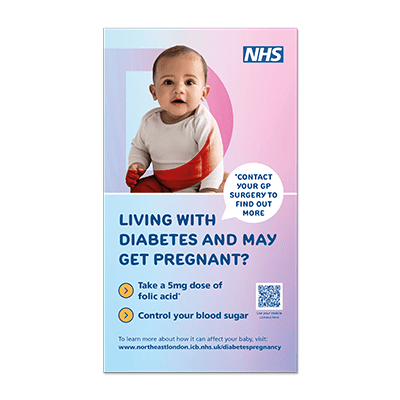
In 2017 a core NEL Sustainability and Transformation Partnership preconception workstream was formed to launch the HELENA project. The team engaged with public health, sexual health and family medicine, community pharmacy and the NEL Business Intelligence Unit, North of England Care System Support (NECS), the Clinical Effectiveness Group, Diabetes UK, a private advertising/marketing company and the NEL Maternal Medicine network. NEL has a large population of women of childbearing age with type 2 diabetes so onward referral to a secondary care preconception clinic was unlikely to be feasible or effective. In phase 1 (2017-2019) a NEL-wide preconception template was designed for use during the primary care annual review. It worked with EMIS, SystmOne and Vision and contained SNOMED coded options and hyperlinks to information for healthcare professionals (HCPs). This facilitated a monthly, practice-level NEL-wide dashboard focused on: folic acid prescription; HbA1c ≤48 mmol/mol; HbA1c ≥83 mmol/mol, plus ACE inhibitor/statin prescription in women not known to be using contraception. Education sessions were run for GPs and practice nurses to raise awareness of preconception, referral pathways and template training. Phase 2 (2020-2021) involved virtual MDTs with local primary care teams at borough level where practice-level dashboards were discussed. Phase 3 (2021-2023) focused on raising awareness among women with diabetes. A preconception webinar was run with Diabetes UK and adverts were placed on billboards at supermarkets and bus shelters. A preconception leaflet was designed to accompany retinal screening letters and for use in GP waiting rooms. A desktop primary care guide for HCPs, GP practice and pharmacy posters, plus a standard text and letter for practices to send to women were created. A LIS was launched to increase folic acid prescription by 10% in Barking, Havering and Redbridge.
Equality, Diversity and Variation
More than half (53%) of the population in NEL is Black, Asian or Mixed ethnicity. Across NEL, approximately 489,000 (24%) people live in areas ranked the most deprived 20% in the country. A quarter speak a language other than English as their main language, with Bengali (4%), Urdu (2%) and Turkish (2%) the most prevalent. The HELENA project leaflets sent to women were published in 11 languages and supported by Diabetes UK’s Engaging Communities team. A ‘Diabetes and Planning a Pregnancy’ webinar was held in January 2022, supported by Diabetes UK, with 215 women registered and 86 attending the live event. The advertising posters were located in areas in Tower Hamlets with the largest expected footfall of target demographic population, namely Bengali women of childbearing age. The Mile End Hospital preconception clinic provided a Bengali link worker for consultations, and education sessions were offered in English and Bengali. The Royal London Hospital offered English and Bengali dietary education and had a Bengali advocate on site.
Results
The standardised template is now part of the routine annual review. The practice-level dashboard is effective at monitoring key outcomes. Phases 1 and 2 were successful in establishing the template, dashboard and the borough-level MDTs. These interventions raised HCPs’ awareness of the importance of preparing for pregnancy in women with diabetes. Phase 3 determined the impact of the awareness campaign through post-marketing analysis and the outcome dashboard. The two adverts ran in digitally rotating billboards in 40 Tower Hamlets locations. Analysis showed that over three months, these reached 1,144,024 individuals and were seen between 2.2 and 5 times per individual. The patient webpage was viewed via the QR code on the advert 12-91 times per day. Preconception advice doubled from a median of 6% of annual reviews in April 2022 to a median 12% in January 2023 in Tower Hamlets GP practices. Data for 83 women with type 1 diabetes attending their booking appointment at the Royal London Hospital showed an improvement in pregnancy preparation, with 33.3% of women achieving HbA1c <48mmol/mol in the first trimester in 2018-2022, compared to 17.6% in 2014-2017. Folic acid usage prior to pregnancy increased from 60% in 2014-2017 to 62.5% in 2018-2022. In Barking, Havering and Redbridge the LIS on folic acid prescription in women with diabetes showed prescriptions increased from a median 16% to a median 21%. Preconception advice increased from median 2.2% in 2021-2022 to median 29% in 2023-2024.
User Feedback
The project was supported enthusiastically by all stakeholders. The borough MDTs were well attended by primary care clinicians and commissioners. The primary care template was adapted to be shorter following feedback and practice nurses encouraged to signpost to other resources or refer for more detailed medical consultations with their GP or in the preconception clinic. Women were also referred to the community diabetes team for tightening of glycaemic control. The desktop Primary Care Guide was co-designed with primary care clinicians and incorporated key facts for consultations, based on their requirements.
Dissemination and Sustainability
The HELENA project successfully embedded preconception advice into the primary care diabetes annual review and resulted in increased folic acid prescription. The incentive scheme in the pilot BHR area increased preconception advice and folic acid prescription, and rollout to the other NEL boroughs is planned. Women with type 1 diabetes were better prepared for pregnancy (2018-2022). Initial proposals presented at the Diabetes UK Diabetes and Pregnancy Conference in 2019 received significant interest and requests to share the template. The preconception template and local dashboard would be replicable in all UK health systems. Local incentive schemes could be utilised to increase preconception advice and folic acid prescription.