Summary
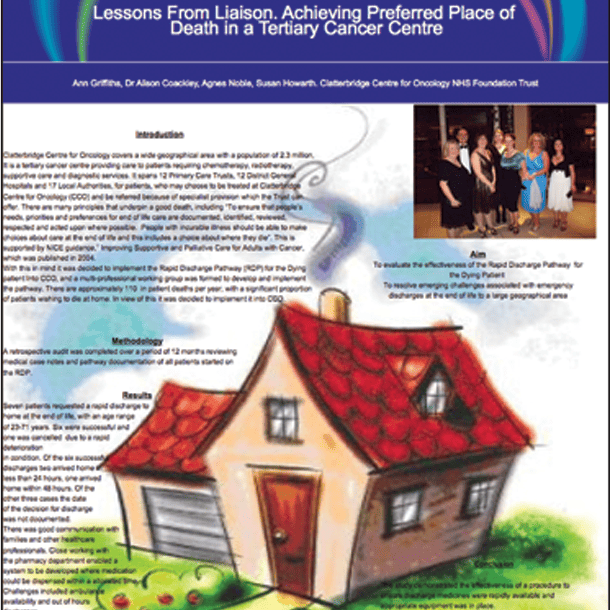
Ensuring that a dying patient and family feel supported during the transfer from a tertiary cancer centre to home is essential. Communication to community teams taking over the care of the patient is vital. A multi-professional working group based at The Clatterbridge Cancer Centre developed and implemented a Rapid Discharge Plan following close liaison with services and personnel across the Network. The Cancer Centre has ensured that patients are accompanied by a trained member of nursing staff who stays with the patient until community teams arrive.
Challenge
In 2004, NICE guidance recommended that incurably ill people be able to make choices relating to end of life care, including where to die. This was highlighted later by the Department of Health.
Arranging a rapid discharge home from a tertiary cancer centre covering a wide geographical area, involving multiple health care teams, and serving 2 million people, can appear overwhelming. Ensuring that the patient and family feel supported during that transfer is essential, as is communication to community teams taking over patient care.
A multi-professional working group based at The Clatterbridge Cancer Centre (CCC) developed and implemented a Rapid Discharge Plan, ensuring that patients are accompanied by a trained member of nursing staff until community teams arrive.
Objectives
CCC aimed to develop a process enabling the transfer home of patients, in the last hours or days of life, who had chosen to die at home. The aim was to discharge them within a maximum of 24 hours, ideally within four. They were to be accompanied by a trained nurse.
Objectives included developing teamwork within CCC, to implement the new process. The team aimed to develop excellent communication and liaison with community health care professionals involved in the patient's care.
The establishment of a system for dispensing medication in a timely manner was necessary. The organisation for urgent delivery of oxygen and equipment to home would be crucial.
Solution
A multi-professional working group was set up, meeting six times over the year.
The pharmacy department agreed to dispense medication for patients within one hour of receiving the prescription. ‘Red dots’ on the prescription chart indicated which prescriptions were for patients being discharged.
The group liaised with the ambulance service who agreed to transfer the patient as soon as possible following referral. CCC Trust agreed that if the ambulance service was unable to fulfil that commitment, a private ambulance would be ordered.
The group also liaised with the community nursing team to discuss the urgent referral of patients. A database of contact numbers for Community Teams across the Network was set up, including Community Nurses and Community Palliative Care Teams. Each ward was issued a folder containing all documentation required for the process, and the Trust agreed to support escorted discharge home for the patient by a trained nurse.
Results
Six dying patients requested rapid discharge home last year. All requests were completed successfully. An information folder was developed, and helped the team locate all the information and documentation needed in a timely manner. Liaison with primary care services across the network was productive.
Ordering oxygen proved straightforward, but ordering equipment was a challenge. All requests for ambulance transfers where completed in a timely manner. All of the patients discharged home were escorted by a trained nurse from CCC. This was reported to be invaluable by the community nursing teams. Nurses and GPs appreciated the face-to-face handover. Patients and families appreciated the presence of a familiar face during the transfer and handover.
Learnings
There were a number of lessons. Firstly, the teamwork involved was fundamental to the project’s success. The multidisciplinary team brought valuable knowledge and experience.
Working with a large number of community teams involved much discussion on the setting up of the project. This communication continues with each patient, the team has found.
The provision of a trained nurse to escort the patient home is crucial, and would be an important consideration in the development of any initiative.
Following a rapid discharge process, it is important to provide feedback to all members of the multidisciplinary team in the hospital, as not all members of the team are ward-based. This can be achieved face-to-face, by phone or electronically, and must be prompt.
Evaluation
All patients who chose to go home to die did so in the allocated time. None were re-admitted or re-referred. Close co-ordination, good communication and teamwork, and support for the patient and family were essential.
There was a positive impact on the hospital team, who were encouraged by feedback from the escorting nurse. This continued the day after the transfer, with a follow-up phone call by staff to the family or carers. This was shared with the team. The most important impact has been on the patients and their families or carers. This was outstanding.
Other cancer centres could easily adopt and localise this project. The liaison and details of contacts is a substantial task, but crucial.