Summary
This joint project between Queen Alexandra Hospital and Portsmouth NHS Trust involved the diabetes team, maternity team and community midwife team collectively improving outcomes in diabetes-related pregnancies through a redesign of existing diabetes maternity and midwifery services - incorporating better seamless service infrastructure and education, diabetes pregnancy awareness for patients and service delivery. The international St Vincent's Declaration of 1989 for Diabetes declared that health care professionals should achieve pregnancy outcomes in women with diabetes that approximate that of women without diabetes. The team believes its outcome measures, achieved through substantive service redesign and collaboration of several multi-disciplinary teams, demonstrate that health care professionals can step up to the challenge set by the St Vincent's Declaration.
Results
Between 2010 and 2015, diabetes-related pregnancies rose progressively from 210 to 371 per year, an increase of 177%. In part this increase was due to a successful campaign to increase GTT screening (increased 7.5 fold) to identify GDM after we demonstrated that a fasting glucose measurement missed up to 95% of GDM diagnoses. In spite of this huge increase in diabetes pregnancies, we achieved the following outcomes in 371 deliveries during the last 12 months:
a) 3/371 (0.8%) babies with a weight greater than 4.5 kg
b) 1/371 (0.3%) intra-uterine deaths
c) 0% neonatal deaths
d) 2/371 (0.6%) congenital abnormalities
e) 16/371 (4.3%) intra-uterine growth retardation
f) 16/371 (4.3%) neonates transferred to the neonatal unit with hypoglycaemia
g) 284/371 (76.5%) mothers were breast feeding
h) a progressive increase in mothers receiving pre-pregnancy counselling (1.8 fold increase).
Challenge
The diabetes, antenatal and community midwife teams recognised the following challenges needed to be addressed in order to deliver a high quality ante-natal diabetes service for the population of Portsmouth: an exponential rise in the number of patients with diabetes related pregnancies; significant under-utilisation of glucose tolerance tests to diagnose gestational diabetes (GDM) and reliance upon a fasting glucose level to diagnose GDM; limited interaction between the community midwifery service and the specialist diabetes ante-natal team; and better utilisation of limited resources within the diabetes ante-natal team and the requirement to demonstrate need and quality outcome to support a service redesign/expansion.
Objectives
To build a new model of collaborative and innovative multi-disciplinary team working involving diabetes and antenatal HCPs as well as community midwifery team to enhance patient continuity; improve mother and fetal/neonatal outcome; manage an ever growing diabetes maternity population; and enhance confidence in local diabetes maternity care.
Solution
Service requirements have grown exponentially. From 2002-7, 324 diabetes-related pregnancies were recorded. This compared with 371 diabetes related pregnancies within the last 12 months alone. Diabetes complications such as macrosomia were also high at baseline (4.6%). In order to overcome these challenges, the team substantively redesigned its diabetes ante-natal services with an eight point plan which included:
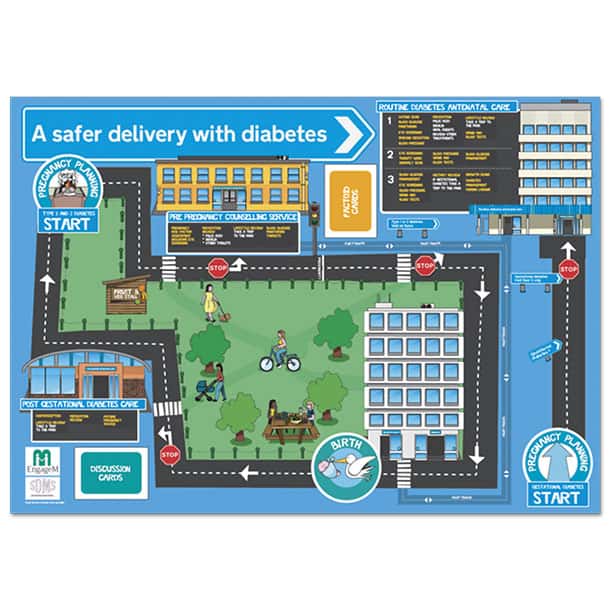
- development of a community diabetes midwifery network using existing midwives skilled to identify patients with (or at risk of) diabetes to ensure appropriate screening and management
- development of two dedicated diabetes specialist midwives (redesign of existing midwifery funding) as a pivotal link between the diabetes and antenatal teams
- extensive education throughout the district on the importance of GTT vs a fasting glucose level in the diagnosis of GDM, paralleled by an increase in GTT resource availability
- development of group educational sessions (PADDLE, Pregnancy and Diabetes, Developing in a Learning Environment) – a weekly multi-disciplinary education group attended by newly diagnosed GDM mothers
- identifying and providing information to women with diabetes of child-bearing age the importance of pre-pregnancy counselling (over 900 women received a mail shot)
- establishing a dedicated pre-pregnancy counselling service for women with diabetes
- development of an extensive education programme to educate all health care professionals locally on the importance of diabetes pregnancy counselling, management and after care (part of the Diabetes Multi-Health care Programme of Learning) developed in affiliation with the University of Portsmouth
- extensive re-organisation of existing diabetes maternity protocols so they met NICE guidelines.
Learnings
All aspects of the eight-point plan are now deeply embedded within the diabetes pregnancy service and despite the rapid increase in diabetes related pregnancies, and the team is confident it can maintain these benefits for our diabetes mothers and newborn. Annual data between baseline and the data for the last 12 months shows these trends in improved outcome have been progressive.
Evaluation
How do these figures evaluate alongside the general population for deliveries? Where comparable data is available: intra-uterine deaths were lower (0.3 vs 0.47 %); much lower neonatal death rates were observed (0 vs 0.26%); and congenital abnormalities were over seven times lower (0.6 vs 2.27%).