Summary
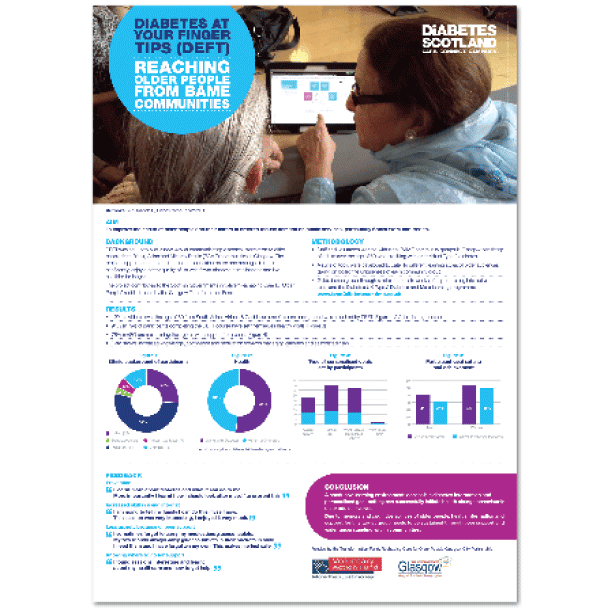
DEFT was set up to pilot a new way of communicating diabetes information and services to older people from Black, Asian and Minority Ethnic (BME) communities in Glasgow, supporting them to understand the condition better and manage diabetes confidently, enjoying a better quality of life with fewer diabetes complications, and living healthier for longer. Over 17 months, staff and volunteers helped participants understand the risks of developing Type 2 diabetes and related complications, and supporting them to deal with the daily responsibilities of self-management. Data shows 92% of participants set themselves healthy goals and 85% took steps towards reaching them. Groups are sustaining healthy activities by linking with local services and providing peer support to one another.
Results
Data showed that knowledge improved across all areas of diabetes covering myths, misconceptions, risks, causes and impacts of diabetes. Follow-up visits indicated this knowledge has been retained 8 weeks after DEFT sessions were completed. 112 participants (92%) set themselves personal goals to better manage their diabetes or reduce risks of developing Type 2 diabetes – and 95 participants (85%) had taken initial steps to achieving their goals. When it came to online education, 64 participants learned new skills by using tablet PCs for the first time, with 82 participants feeling confident in being able to access information online. Open discussion about diabetes and treatment led to reduced stigma of diabetes, with 14 participants who were very worried about diabetes at the start of the project indicating they were less worried at the end of DEFT as they now know that diabetes can be self-managed.
Challenge
It is estimated 23,000 people with Type 2 diabetes in the Glasgow city area are over the age of 65. By the age of 80, twice as many British South Asian, Black African and African Caribbean men and women develop diabetes compared with Europeans of the same age. BME groups can experience greater problems in accessing good quality, culturally sensitive information and services which compound their vulnerabilities, making them more at risk of experiencing the effects of health inequalities.
Objectives
To get 90 older people from BME communities with Type 2 diabetes, or at risk of developing it, to: have increased confidence to look after their own health, making simple changes to their lives; increase their independence by learning to use the internet to access local resources; and to reduce stress and anxiety about diabetes, due to an improved support network around them.
Solution
DEFT identified and approached community groups to gauge interest in diabetes, exceeding the target of 90 by signing up 122 individuals in 8 groups for the service. The natural make-up of these groups consisted of 52% participants living with Type 2 diabetes. The team developed a range of tools based on the diversity of the groups and their preferred ways of learning and understanding information. Alongside the main tool www.type2diabetesandme.co.uk visual tools, games and activities that included culturally appropriate information and also took into account literacy issues. Volunteers were recruited and trained to support staff to deliver the sessions and they were a huge asset when encouraging older people to try out tablet PCs and e-learning. Six weeks of support was delivered to each group, covering all aspects of managing the risks of, and living well with, diabetes. Sessions also included goal setting, balance exercises, basic internet training, music and games, focusing on participants’ wider wellbeing. Follow-up support sessions were conducted 8 weeks after the groups completed their learning sessions, to encourage and motivate participants to keep to their goals.
Learnings
There is no one-size-fits-all method to deliver health information, and we need to be responsive and flexible to learning styles and abilities. English literacy was not high in most DEFT participants, and this was a challenge when introducing the e-learning programme. However, most groups took on the challenge and learnt their way around the tablet and its functions. Tools such as FoodFit overcame language boundaries and were incorporated in the session plans for all groups. Supporting behaviour change is most successful when it is personalised, and therefore individual goal setting increases the likelihood of older people sticking to their goal. Most DEFT participants struggled to remember information a few weeks after session delivery: it is therefore important that support interventions for this group need to be sustained rather than delivered on a short term basis.
Evaluation
Several participatory tools were used to collect data to measure project outcomes including Q&As, case studies, group activities, 1:1 feedback and session reports.