Summary
The Robert Ogden Macmillan Centre has been involved in a variety of projects to improve Hair Loss Support Services for cancer patients at Leeds Cancer Centre.
Training of hair loss support staff and a focus group undertaken with the Black Health Initiative led to improved acceptability of the wig service in this community.
The centre worked very closely with local wig supplier to increase the range of wigs on offer under the NHS scheme, resulting in better choice for patients.
An electronic catalogue has been developed specifically for the Hair Loss Support Service at Leeds Cancer Centre, which includes a diverse range of models to improve appeal and acceptance with the wider patient community and different groups.
A room in The Cancer Centre has been furnished into a hair salon to allow patients to be seen in a suitably private location, closer to where they receive treatment.
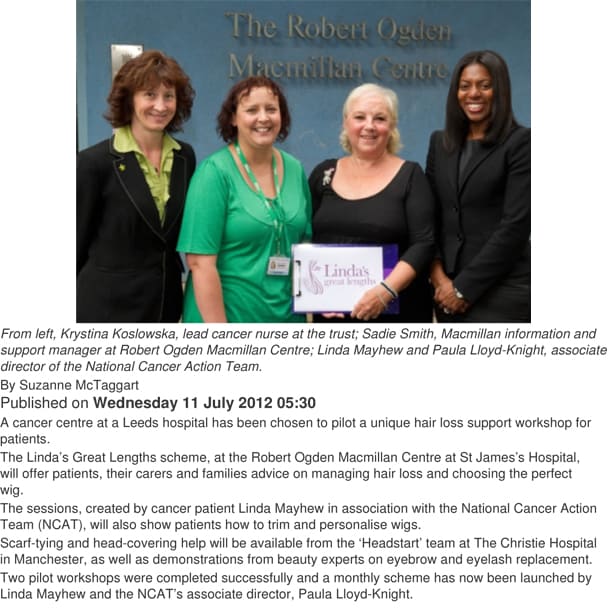
The team has taken part in piloting ‘Great Lengths’ hair loss support workshops with the National Cancer Action Team. The two planned pilot workshops have been such a success that the team are continuing with this format monthly.
Objectives
Through a variety of intitiatives we sought to improve:
- equity of the hair loss support service, improving acceptability with a wider range of patients, addressing cultural and ethnic needs.
- improved access to the service for patients who were receiving treatments and were unable to travel to the centre.
- the way we deliver care, enabling those who would prefer it to receive hair loss support in a group setting.
Solution
1) The project officer led a focus group at the Black Health Initiative. The manager Sadie Smith and the hair loss support workers presented to a group of ladies to discuss current hair loss support services and show examples of wigs supplied.
The focus group raised concerns which included that they did not know that the service was ‘for them’. They were not convinced that the support workers would have the specific cultural knowledge to support people from different backgrounds and they thought the wigs would not be appropriate for women of their culture.
The ladies were pleasantly surprised with the range of wigs available that were suitable for them. We identified that there were some training needs for the hair loss team regarding cultural issues. It was acknowledged that the suppliers wig catalogue was not suitable and some of the ladies in the focus group volunteered to model for a bespoke catalogue.
The supportive care coordinator approached a couple more ladies who had used the hair loss support services to see if they would also be interested in modelling for the catalogue.
The manager, supportive care coordinator and deputy head of contracts worked closely with the wig supplier to improve the range of wigs available, including wigs for different ethnic communities. The supplier also agreed to make a bespoke electronic catalogue of the wigs available to include the photos taken with the diverse models alongside the current model shots they had. The deputy head of contracts managed to recruit a male volunteer for the wig photo shoot and the staff at the wig shop were able to encourage children to be involved.
The centre manager arranged for some cultural training with a wig consultant. The hair loss support workers and centre manager attended training on the “Cultural Differences in Black Afro Hair”. The training session was very comprehensive covering issues of hair care and wigs for this group and included a question and answer session giving staff the opportunity to increase their understanding.
2) The Information Nurse Specialist, Josie Sharp, was able to secure an unused room to be used for the support workers to see patients within the Leeds Cancer Centre, closer to where treatments are given. The room has been furnished as a hair salon and will be used to see patients from July 2012.
3) The team were approached by the National Cancer Action Team to be a pilot site for a patient led initiative; a Great Lengths Hair Loss workshop. This involved running workshops where patients come with their friends/family to learn about hair loss, wig fitting, and hair regrowth from the Hair Loss Support Workers. Demonstrations were also provided on alternative headwear from trained volunteers and advice was offered on eyebrow penciling and eye lash enhancing from beauticians. The group sessions enhanced existing practice, provided a relaxed and informal atmosphere encouraging peer support and have been adopted as a model to be continued going forward.
Results
The variety of work streams have led to a more equitable, accessible and comprehensive Hair Loss Support Service which meets the individual needs of cancer patients.
The wig suppliers have placed more wigs into the range available for the Hair Loss Support workers to provide to patients, improving acceptability with a wider rage of diverse communities.
They have used the photos taken with our volunteer models from different ethnic backgrounds to create and launch an e-catalogue specific to Leeds Teaching Hospitals Hair Loss Support Service.
The Hair Loss Support Workers are more confident in providing their services for people of different cultures following the training they received.
The Great Lengths Group workshop pilot sessions were very successful. The National Cancer Action Team are writing up a report of the pilots from 3 different sites. We have decided that we will roll out the workshops monthly, both patients and nursing staff have commented favourably on the support these sessions offer. Patients would recommend them to others.
We now have a hair loss support room available in the Cancer Centre to enable patients to see the hair loss support workers in a private environment. This improves patient experience and access to the service and allows the team to have a wider range of products available to them when they are seeing patients.
Evaluation
Bespoke e catalogue available for patients to access from home or within the service. Marva Pryce, Black Health Initiative Cancer Project Coordinator has fedback her delight at the improved catalogue.
With the workshop and service promotion we are seeing more patients accessing hair loss support throughour services where they previously accessed support from local wig shops within the NHS framework.
We are waiting for the official evaluation of the Great Lengths workshops from the National Cancer Action Team though we are so confident with the success of the pilots that we are already holding the workshops monthly for all patients to have the opportunity to attend.
The team have been encouraging patients to complete feedback forms about their experiences of the service. Over the six months Jan-July we have had 163 feedback forms completed - comments include:
- “first class service”
- “Hair dressers very knowledgeable, great advice, experts”
- “felt at ease”
- “a positive experience” “better than I expected”
- “sensitive and private”
- “professional”
One lady, interviewed for the local newspaper said she:
- “wasn’t keen on the NHS provided wigs she had previously seen, especially as she felt there weren’t any to suit women of Afro-Carribean backgrounds….The service ..is brilliant…They had a really good supply of wigs …They also had a lot of knowledge about Afro-Carribean hair and wigs”
Innovation
As far as we are aware there are no other Hair Loss Support Workers employed in cancer services Nationally. Feedback from NCAT also suggests we are unique.
So far, we have managed to make big improvements to our services incurring very little cost. Much of the work undertaken has involved members of staff in the team, the involvement of service users, volunteers and wig companies. Staff members were supported through management lines to be able to take on the initiatives.
We have a Charitable Trust Fund within Leeds Teaching Hospitals NHS Trust to support patients who lose their hair due to cancer treatments. We have been able to use this donated money to fund the furnishing of the new Hair Loss Support Room in the Cancer Centre at £991.20.
We paid a professional photographer to take the wig shots on our models at £100.
The cultural training with a wig consultant was provided free of charge though a donation of £100 was made for the session.
Giving a total of £1191.20 for the improvements made.
Impact
We will continue to measure the impact of the developments in the hair loss services by evaluating patient experience and asking the users of the services for their feedback. We will go back to the Black Health Initiative in 6 months to review impact
We continually monitor the number of referrals we have for the service, the number of patients that book in to see the hair loss support team and the number of people who attend the hair loss workshops. We plan to further evaluate this data to ensure we capture information about the ethnicity of the patients using the services.