Summary
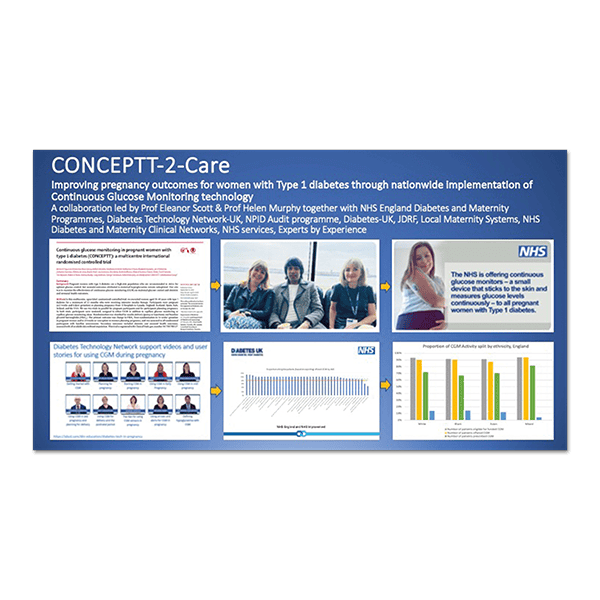
The CONCEPTT trial established that continuous glucose monitoring (CGM) improved maternal glucose control and neonatal outcomes for pregnant women with type 1 diabetes (T1D). Working with stakeholders across traditional boundaries, an implementation package was co-produced, delivering CGM to all pregnant women with T1D in England. To date, 98% of pregnant women with T1D have been offered CGM with no inequalities based on ethnicity or social deprivation. NPID data showed significant improvements in maternal glucose across pregnancy and pre-term births, plus large-birthweight babies and neonatal care admissions started to decline for the first time, saving the NHS ~£9.5 million/year.
Innovation
Women with T1D have poor pregnancy outcomes; half have pre-term births and large-for-gestational-age babies, with one in every two babies admitted to a neonatal care unit (NCU). Maternal glucose is the major modifiable risk factor, but there has been no improvement in this or pregnancy outcomes for the past two decades. CGM, with its detailed, real-time glucose information, should help pregnant women achieve their glucose targets more readily than the fingerprick test, but it is far more expensive. The CONCEPTT trial set out to show that CGM in pregnancy improved maternal glucose and babies’ health outcomes. CGM was not only clinically- and cost-effective, but was cost-saving for the NHS. The challenge was to rapidly and uniformly translate this into NHS care, so that all pregnant women with T1D, across all antenatal clinics, were offered CGM. The organisers worked with NHS England Diabetes Programme leads on a national implementation model and predicted costs. Ring-fenced funding was obtained for two years. The core working group involved regional Local Maternity Systems (LMS) networks, holding meetings and regional webinars with them to explain the process. The LMS collected data on CGM offered/ NHS maternity clinic. The NPID audit was modified to record who was offered/ accepted CGM and determine its effect on maternal and neonatal outcomes.
Equality, Diversity and Variation
The women with T1D who have the poorest pregnancy outcomes are those with suboptimal glucose control, as assessed by HbA1c. Those more likely to have poor pregnancy outcomes are also those who are socioeconomically deprived and of ethnic minority origin. These two groups are less likely to have access to technology, with associated healthcare inequalities. Data shows that pregnancy outcomes are influenced more by individual characteristics of the women with T1D, not variations in their care. This meant that any intervention had to be delivered system-wide, to all pregnant women. Work with regional LMS teams built confidence, reducing variation in access at different sites. Diabetes Technology Network-UK (DTN-UK) helped to develop an educational support toolkit for workers and pregnant women, with input from diverse patients, diabetes charities and healthcare teams. A Best Practice Guide on Technology in Pregnancy was produced with DTN-UK and HCP- and patient-led videos provided support throughout pregnancy. During COVID-19 restrictions, CGM workshops were run to upskill and support HCPs, ‘Top Tips’ leaflets were produced for pregnant women, plus ACADEMY educational training modules were developed, so HCPs could gain accreditation, again reducing variation. CGM reduced the chances of maternal and neonatal morbidity, reducing inequalities. Improving the sizes of the babies reduced future risk of inequality from obesity, diabetes and cardiometabolic disease.
Results
Widespread stakeholder engagement and ring-fenced funding from NHS England to implement CGM to all pregnant women with T1D, across all NHS maternity services, were attained and a national implementation pathway was activated. Educational support provided CGM safely and effectively, in collaboration with DTN-UK, JDRF, Diabetes UK, Digibete and service users. Uptake was measured and ensured no access inequalities. Preliminary NPID audit data on maternal and neonatal outcomes showed real-world beneficial effects of using CGM. The plan was implemented between March 2021-March 2023, with March 2023 surveillance data from LMS showing 98% of all women with T1D pregnancy across NHS England had been offered CGM, with no healthcare inequalities based on ethnicity or social deprivation. Following implementation, NPID audit data showed the first national improvements in maternal glucose control throughout pregnancy, across all clinics. Early pregnancy HbA1c was lower, with improvements in maternal glucose levels sustained throughout pregnancy and lower HbA1c in late pregnancy. Pre-term births, large birthweight babies and neonatal care admissions declined for the first time since NPID records began. The total annual costs of managing pregnancy and delivery in women with T1D in the UK are £23,725,648 with fingerprick, and £14,165,187 using CGM. Efficiency cost savings to the NHS are approximately £9.5 million/year.
User Feedback
This translational project involved people across many organisations. Working collaboratively, without boundaries, transformed NHS patient care. Cloud-based access to CGM data enabled healthcare teams to monitor women remotely, improving clinic flow, plus patient and HCP satisfaction. It also enabled the team to focus on tailored treatments. Feedback from women with T1D was that CGM implementation for pregnancy had been transformative. The toolkit had positive feedback. It has been accessed by all NHS trusts and remains freely available.
Dissemination and Sustainability
This project was implemented uniformly across the NHS in England, involving collaborative work between departments, across organisations and local boundaries. It included patient-focused charities and experts by experience. Results on CGM uptake have been shared with all stakeholders, through the National Diabetes Programme Board, Diabetes Clinical Networks and National Diabetes Audit Partnership board, plus presented at conferences and through social media. Data collected by NPID audit showed improved maternal and neonatal outcomes and pregnancy experience and is being prepared for the State of the Nation report 2023 and international peer reviewed publication. Although funding for CGM has finished, a new diabetes element has been added to the Saving Babies Lives Care Bundle (May 2023), focused on improving outcomes through mandatory use of CGM in T1D pregnancy. Stakeholder comments to NICE Quality Standards for Diabetes in Pregnancy 2023 ensured that using CGM was one of five standards. This process is a great example/model for future projects within the NHS and internationally. It will be used for the rollout of closed-loop technology.