Summary
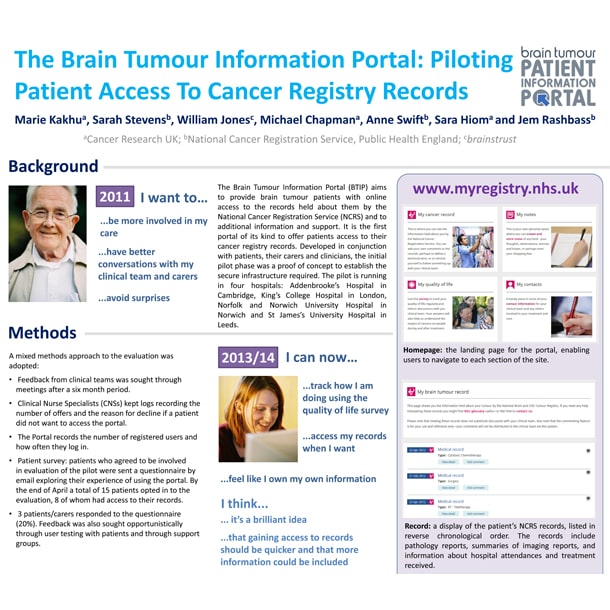
This project aims to drive patient engagement in cancer care via the brain tumour information portal, a secure website that provides patients access to their records held by the National Cancer Registration Service (NCRS). The concept was established following a need voiced by the brain tumour patient community and has been developed in close partnership with patients and clinicians. The NCRS collects information about all cancer patients resident in England, including histopathology reports, summaries of imaging reports, data on radio- and chemotherapy and Patient Administration System data. Patients can make their own notes, record the contact details of their clinical team(s) and undertake quality of life surveys.
Challenge
The need for the portal was identified by cancer patients themselves; the brain tumour patient community wanted to be more involved in their care, have better conversations with their clinical team and carers, and avoid surprises. They believed that access to their registry records, which contain detailed information about their tumours, would help achieve these. Patients with other cancer types also supported the development of the portal.
Under the Data Protection Act 1998, patients have a legal right to access their own personal healthcare records should they wish to. The portal allows this, as the information held belongs to the patient. Another benefit of the portal is that it allows patients to check the accuracy of their own information.
Objectives
The team wanted to develop secure and scalable systems and processes for online access to NCRS records. This would involve building a system allowing the secure transfer of records from the NCRS repository to the portal. This involved developing processes for retreiving records, validating patients’ identities and and enabling patients to opt into the project’s evaluation questionnaire.
They also wanted to demonstrate an interest from brain tumour patients in accessing their registry records. This required measuring the uptake rate for the site.
The team also aimed to gather feedback from patients and carers about the benefits of the portal. Their final objective was to assess the impact on clinical teams of providing record access to their patients.
Solution
The secure patient portal infrastructure was developed by the NCRS to allow the transfer of patient records from the NCRS database to the portal.
Patients could create an account on the BTIP website and request access to their records. Once records were retrieved and matched by the NCRS, the patient contacted their Clinical Nurse Specialist (CNS) to verify their identity and unlock their portal account.
Uptake was measured by CNSs recording the number of patients receiving information about the BTIP and the number then requesting access to records.The portal recorded registered user numbers and log-in frequencies.
Information on expected and realised benefits was collected through a ‘diary study’. Feedback was also gathered through clinical teams and at support groups.
Results
By the end of April 2014, 28 patients had requested access to their records and 15 had accesssed them. Users logged in frequently at first, before this dropped off to occasional use. The portal appealed to patients with lower grade tumours and those in long-term follow up. Feedback sessions with patients with other cancer types revealed that the portal is also a very attractive tool to them.
Diary study respondents reported the benefits as having access to their information, being able to monitor their wellbeing over time, and to process information at their pace. Clinical teams have found this manageable within their existing workloads.
Learnings
The team developed a secure infrastructure to provide brain tumour patients with secure, online access to records in a way that is scalable across England and to all cancer types. Although the number of users is small, they demonstrated a demand from brain tumour patients for this service.
Respondents unanimously agreed that the time waiting for record access was a drawback. The portal was seen better for those undergoing longer term treatment than those immediately post-diagnosis or reaching the end of their life. All patients wanted to access more information, in particular radiology images.
Technology could be a barrier for clinical teams. Not all sites have computers in clinic rooms and software was not always sufficiently up to date.
Evaluation
The team measured the impact of the portal on patients through a short email questionnaire. They expected greater access to information to help them to feel more involved with their care. Early feedback supported this. The aim is to undertake further evaluation as they increase the numbers of users. This will include exploring how the portal has changed knowledge, attitudes and behaviour in patients and clinicians, and in turn whether (and potentially how) the portal has had an impact on patient experience.
As cancer registration operates on a national scale, any clinical team can become involved and any cancer patient can request access to their records, regardless of their location. This makes the system inherently scalable.