Summary
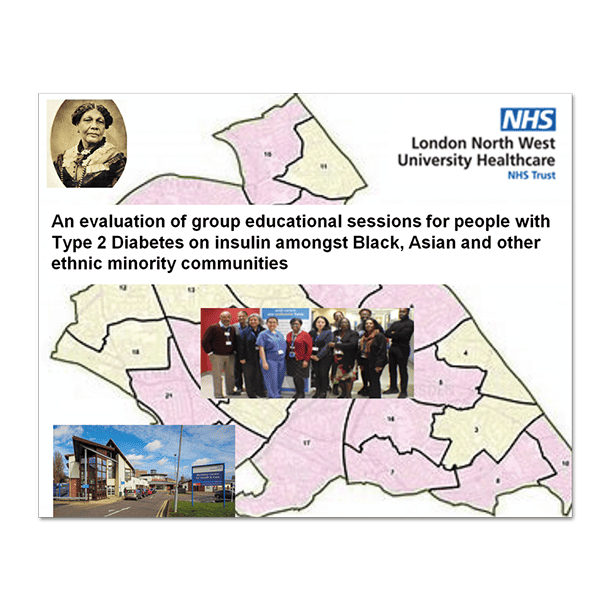
The project evaluated group sessions for Black, Asian and other ethnic minority communities with type 2 diabetes (T2D) on insulin at GP practices and the Brent Diabetes Service. It explored whether giving groups of people with similar culture and languages the opportunity to discuss managing their diabetes while on insulin, in conjunction with specific foods relating to their culture, could improve their blood glucose (glycaemic) control. It also worked with healthcare professionals in primary care to support people with diabetes, carers and families, as people registered with T2D differed in culture, food and languages spoken.
Innovation
People with T2D on insulin continued to have high HbA1c. Local dashboard population health data indicated that approximately 13% of 29,515 people registered with diabetes had HbA1c over 75 mmol/ mol. A search at five GP practices found 34% (216 people) with T2D were on insulin out of 628 people with HbA1c over 75 mmol/mol. Challenges included non-attendance at follow-up reviews, out-of-date or wrong contact details, a need for translators for people who spoke different languages, and face-to-face contact reserved for people who did not have access to technology for the virtual session. This project was an opportunity to target specific ethnic groups using their language, to discuss their cultural foods and how to manage diabetes while on insulin to improve blood glucose levels. The virtual group sessions were held at GP practices alongside a primary health care professional, to enhance partnership working. They aimed to upskill and involve people, their carers and family to implement a safe and effective care model. Participants were recruited from GP practices, with six to eight people per virtual group session. Google Translate was used to translate the presentation into Tamil and Hindi. The presentation design was simple, with pictures to reflect the words. Data were anonymised and collected in a spreadsheet for review of the post-session HbA1c results. The information accessed using the GP systems was managed by the Information Governance structure and individual patient discussion outcomes were recorded on the Trust system during the virtual clinics.
Results
Evidence demonstrates that culturally-appropriate group education had an impact on HbA1c in the short term. Hence, this project looked at the local population and involved family in group discussions to share experiences and support behaviour change. Focus group session reviews indicated that, previously, 78% were unaware of their HbA1c level or what a normal level was. Fourteen females and 13 males attended the sessions, with a mean age of 59.9 years. The mean number of years with HbA1c above 75 mmol/mol while on insulin was three years. The mean HbA1c before the group session was 93.4 mmol/mol and post-session (approximately three months later) it was 65.8 mmol/mol, with the mean change in HbA1c 27.6 mmol/mol. This demonstrated improved outcomes from attending the session. Critical to Quality (CTQ) and Voice of the Customer metrics were used to improve quality and efficiency. Insulin group sessions specifically for Black, Asian and other ethnic communities, in partnership with health care professionals, showed a reduction of HbA1c. The groups should be considered as an option in primary care networks for helping to address health inequalities. Lowering HbA1c helps improve glycaemic control, which would be reflected in the National Diabetes Audit data. Reducing complications or admissions associated with hyperglycemia and hypoglycaemia, would bring wider cost savings.
User Feedback
The project was very well received, particularly for its focused approach. Health professionals who worked in partnership for the session said they provided simple, basic information for people to recap what they should be doing and were informative. To minimise bias, feedback was collected individually and within the group as CTQ metrics. The feedback demonstrated that virtual group insulin sessions in specific languages should be considered an option to support people with T2D.
Dissemination and Sustainability
The learning from this project has been incorporated into clinical practice in providing virtual insulin group sessions in different languages with translators in the diabetes service. The health care providers involved plan to continue group sessions in conjunction with the specialist diabetes service support for primary care. The project only focused on the HbA1c target, to mitigate hypoglycaemia risks and safer use of insulin in primary care. The model can be implemented by primary care with support from specialist diabetes team working in the community. The learning should be scalable, sustainable, and cost effective, both in the shorter and the longer term. The virtual sessions could improve access for people with T2D on insulin from the ethnic minority groups to discuss insulin safety and cultural foods in their own languages. It would be easy to replicate this in primary care and in conjunction with the one-to-one service.