Summary
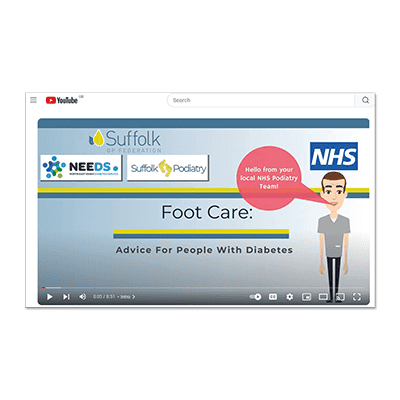
Lack of knowledge of the seriousness of diabetic foot disease and the vital need for prompt specialist input directly impacts patient care and increases the risk of poor patient outcomes and litigation. An innovative educational footcare video was created as an alternative to paper leaflets and ad-hoc face-to-face education. Based on national guidance, this high quality, mixed media video is free and accessible via YouTube. It promotes appropriate self-care and monitoring to prevent more serious foot problems.
Innovation
Previously, the ICS had multiple dull education leaflets, many with outdated information, poor imagery or sponsored by drug companies. Apart from ad hoc patient engagement events and leaflets there were no other education materials and no clear strategy to improve knowledge of diabetic foot disease within the population. No one held overall responsibility for patient foot care education provision and footcare education took place during face-to-face appointments, meaning a lack of consistency in content and delivery. The solution was to create a free, innovative educational video that was stimulating, engaging and easily accessible to people with diabetes (PWD).
Equality, Diversity and Variation
Engaging with PWD, specialist podiatrists, consultants, diabetes specialist nurses and management across the ICS guaranteed equal opportunities to help develop an effective patient education strategy. It was essential to remove barriers to PWD having access to first-class, evidence-based foot care education. Research and UK-wide audits showed that people from certain ethnic backgrounds or low socioeconomic areas were less likely to receive good diabetes care and education. This was echoed in a local review of lower limb amputation that found the amputation rate was 11 times higher for those living in areas of high deprivation compared to those living in areas of low deprivation. This project aimed to make sure that every PWD would have a baseline level of knowledge on how diabetes can affect the lower limb and feet and, importantly, what to do should a foot problem develop. Existing videos on diabetic footcare education were unprofessional, boring, out of date, not applicable to the UK or did not follow national guidance. A collaborative working approach ensured that healthcare professionals (HCPs) from different professions and ethnic backgrounds had input into the new video content, helping to ensure that complex pathologies, such as peripheral neuropathy and peripheral arterial disease, were explained in an accurate yet simplified way. The video was animated so it could be amended easily and voiced over in different languages. Also, publishing on YouTube enabled the viewer to select subtitles in multiple languages and those with hearing difficulties could utilise subtitles. The video was of a quality suitable for a large screen so those with visual impairment could access it.
Results
The project was funded with transformation funds from East of England. However, to ensure the project and future expansion of patient education videos would be sustainable with minimal costs, the team purchased a software package so animated video could be built in-house, with full control over the product. A 50% reduction in the software package fee was negotiated, as it was being used for health promotion, so the cost was £300. YouTube was chosen as it is the most widely utilised free video hosting site in the UK. The video was highlighted to any PWD referred into podiatry services, including those who self-referred. An invitation to view the video with a direct link was texted out to all existing patients of the diabetes team across the ICS who had consented to receive text messages. A poster was developed with a QR code and web address to display in pharmacies and primary care waiting rooms. A JPEG of the poster was emailed to all GP practice managers, for display on monitors/TV screens in waiting areas. The video was made available on both North East Essex and Suffolk GP Federation websites. It went public in March 2023 and has received nearly 3,000 views to date. A local audit of 50 new referrals revealed that no low-risk patients were referred, saving at least £50 on every inappropriate referral, plus there were no incident reports on late patient presentation for acute diabetic foot pathology six months following the dissemination of the video.
User Feedback
The patient engagement team, including patients, reviewed and modified the script and storyboard to ensure that the content was engaging, relevant and understandable, with simplified language. It was vital that the video was honest and that the level of risk and potential for serious foot problems were highlighted effectively. The best approach to convey difficult information was a combination of animation, photos and video. A draft video was released to HCPs and patient representatives and feedback collected anonymously via SurveyMonkey. This resulted in changes like reducing references to loss of limb and life and greater use of darker skin tone imagery. After release it received positive feedback from HCPs and the public.
Implementation of New Technologies
There was focus on making sure that the educational resource was sustainable. The purchase of the animated software program and the skills gained from developing this video allowed the ICS to develop a suite of free videos to support footcare education provision, including ‘Advice for cutting your toenails’, ‘Poor blood supply due to peripheral arterial disease’, ‘Footwear advice’ and ‘What to expect at your diabetic foot screening’. By using animated content, the videos are less likely to become dated, prolonging their usefulness. This project was developed ICS-wide, but the ‘Footcare for people with diabetes’ video is available on YouTube and was deliberately made to national guidelines. A link to the video has been circulated to the East of England Podiatry leads for wider dissemination. The video can be made more generic and the Diabetes UK representative for East of England may promote an edited version to those members. An article for a UK-wide diabetes publication will promote this project to the wider HCP workforce.