Summary
Effective footcare for people living with diabetes (PLWD) is critical to prevent the serious complications and mortality associated with diabetes-related foot problems. Healthcare professionals’ (HCPs) training, information and resources have historically focused on signs and symptoms expressed in white skin, ‘look for redness’ being the mantra. Yet in dark skin, redness may not be present. In these circumstances critical signs or symptoms may be missed, potentially leading to presentation at late, and limb-threatening stages and consequently requiring more complicated and intrusive interventions. Hence a new handbook was designed to address this inequity occurring in dark-skinned PLWD.
Innovation/Novel approach to an existing problem
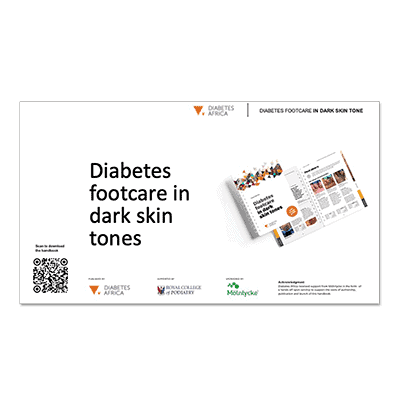
Diabetes footcare training for HCPs typically highlights redness as a red flag sign. However redness, caused by infection and ischaemia, may not look like redness in the foot of someone with dark skin. Identifying skin colour changes in dark skin was rated the most challenging aspect for HCPs in a 2024 Diabetes Africa survey (39%). Additionally, evidence shows patient outcomes and experience in diabetes-related footcare can be negatively impacted by a person’s ethnicity. Therefore a multi-professional group of HCPs and PLWD united to address theses issues, developing the free-to-download digital handbook ‘Diabetes Footcare in Dark Skin Tones’. More than any other diabetes-related complication, footcare is heavily reliant and predicated upon visual signs and symptoms, which are key in making a diagnosis, facilitating and accessing treatment and monitoring progress. Historically, education in this area is based on white, Caucasian skin. For PLWD with dark skin tones, redness may not be present when underlying serious foot conditions are present and 'red flag' symptoms or signs might be missed by HCPs or the person themselves. The handbook addresses this inequity and covers clinical signs and symptoms, helping to standardise the way professionals and PLWD report skin tone and skin tone changes. This makes it easier to identify and record alterations in an individual. The handbook has lots of photographs and quick tips for HCPs and features clinical assessments and visual/audio guides.
Equality, Diversity and Variation
A UK survey of HCPs seeing people with dark skin tones found that approximately 67% had received no formal training on assessing either skin conditions or infections in patients with dark skin tones. Most identified erythema and discolouration as the two most difficult-to-assess symptoms of infection in this population. They requested visual aids and reference images to address these knowledge gaps. For PLWD, the National Diabetes Footcare (2023-24) Audit demonstrated aspects of footcare where health inequalities exist within documented varying outcomes related to ethnicity. The disparities are also evident in US data. These disparities and inequities lead to differing morbidity and mortality rates among different ethnicities, as well as psycho-social effects on the individual, their family and community. The resource addresses the main challenges highlighted by HCPs. Critically, it standardises recording and recognition of skin tones via the ‘skin tone tool’ and a visual resource. It also addresses and facilitates culturally competent communication and differentiates healthy and unhealthy skin.
Impact to Patient Care
Diabetes and diabetes-related foot complications are a global issue, demonstrated by the fact that the handbook has been downloaded more than 30,000 times in five different Continents by a multidisciplinary workforce. Guidelines often point to ‘redness’ or the redness sunset-rhubarb colour of ischaemia around a wound as a critical marker for assessing the severity of an infection. Yet, this redness may present as dark pigmentation or not be visible at all in those with dark skin tones. Similarly, signals like skin pallor or a ‘sunset’ discolouration can elude detection in dark-skinned individuals. The skin tone tool, its importance and how to use it, are key components of the handbook. This objectivity removes historical bias and allows PLWD, HCPs and caregivers to report changes that may represent early signs of diabetes-related foot complications and so prevent escalation of problems. Users praise the handbook’s practical value and report meaningful changes to their clinical practice. HCPs describe it as comprehensive, long overdue, and transformative for patient care.
Results
The handbook set out to fulfil specific learning needs in the recognition of possible differences in the signs and symptoms experienced by PLWD who have dark skin tones. It was produced to improve recognition of possible diabetes-related foot issues and address inequity in the UK and beyond. The aim was to make it easily accessible and widely disseminated and it exceeded all expectations, with over 35,000 downloads in its first year, underpinned with webinars, lectures and conference abstracts nationally and internationally. A post-launch survey of HCPs and academic professionals showed 57.1% found the skin tone tool and photos the most helpful aspects. Others rated its usefulness as a guide and reference for teaching and its use of multimedia. Early feedback indicates that culturally appropriate assessment and diagnosis are improving patient outcomes, with HCPs reporting more confident diagnoses and better patient communication. This project had funding from Mölnlycke (a wound-care-focused med-tech company) via hands-off sponsorship to support the costs of authorship, publication and launch. This meant that the handbook was available freely online, enabling its wide dissemination. The handbook also contains a link to a webinar on footcare in dark skins, which has increased views to over 35,000.
User Feedback
Feedback at lectures and conferences has been taken in the form of verbal feedback and feedback forms. In a formal, anonymous survey in the year following launch, 57% of respondents found the photos and skin tone tools the most helpful. Others rated its ‘practical application’, the ability to ‘distinguishing problems in darker skin tones’ or the fact that 'the photographs are very useful in demonstrating different conditions and I particularly liked how thorough the book is’. Others rated its usefulness as a guide and reference for teaching and its use of multi-media to encompass different learning styles. One of the main objectives of the handbook was to fulfil an unmet learning need of HCPs. This objective was met as survey results demonstrated changes in practice. Suggested improvements included more photos, case-studies and updates, versions specifically for PLWD, a hardcopy booklet, a phone app or a pocket guide.