Summary
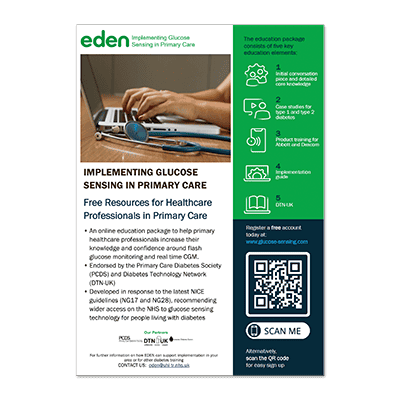
‘Implementing Glucose Sensing in Primary Care’ is an online learning platform developed by Eden in collaboration with Diabetes Technology Network (DTN-UK) and Primary Care Diabetes Society (PCDS). The programme aims to enhance the skills of healthcare professionals (HCPs) working in primary care to support patients living with diabetes in using continuous glucose monitoring (CGM), following the change to NICE guidance in 2022. Since its launch, the programme has engaged 1,036 users from 13 professions, including GPs, practice nurses, clinical pharmacists, allied HCPs and social prescribers, reflecting a broad and inclusive approach to diabetes care education.
Innovation
In 2022, NICE updated its guidance for people living with type 1 and type 2 diabetes, promoting the use of CGM in all people living with type 1 diabetes and some living with type 2 diabetes using insulin therapy. This allowed some CGM devices to be prescribed in primary care. Previously, all people starting and using CGM were supported by secondary care diabetes services. This meant primary care HCPs needed training and support in the use of the technology. ‘Implementing Glucose Sensing in Primary Care’ is an online education programme endorsed by the PCDS and DTN-UK. It aims to increase knowledge and confidence in starting and supporting people living with diabetes using CGM. It provides a variety of interactive learning opportunities to help the bespoke needs and interests of participants, including recorded discussions, online learning modules about FreeStyle Libre 2 and Dexcom ONE CGM systems and their compatible cloud-based systems. Interactive case studies and an implementation toolkit help embed theory into clinical practice. Post pandemic, there is an abundance of education available to all HCPs, much of it online, some free to access. The value of education in changing clinical practice and outcomes has been hard to assess, as it is difficult to directly correlate patient outcomes with a HCP receiving education. Through work with Leicester, Leicestershire and Rutland ICB, Eden has demonstrated that intensive education positively affects patient outcomes. Eden is competency based and supports HCPs to gain both knowledge and the confidence to apply it.
Equality, Diversity and Variation
It has been highlighted in previous local and national audit data that people who live in more deprived areas or are from ethnic minority backgrounds have a lower uptake of CGM. The Diabetes UK campaign ‘Diabetes Tech Can’t Wait’ is focused on ensuring everyone gets the right device. They recognise the significant variation in technology access across ICBs. Policy variation means that many people may face barriers to access. Many primary care HCPs are not familiar with CGM in their day-to-day practice. There is also the perception that the use of CGM can be labour-intensive and time consuming, requiring extra training and skills among a pressurised workforce. While any new technology requires a period of training and familiarity, CGM use can save time in the longer term. The education programme raises awareness about inequality and highlights what HCPs can do to make a positive difference. The programme has been recognised for its value in providing appropriate education in a number of places. To ensure equitable access for HCPs the NHS Library Health Literacy tool’s guidance on written and oral communication was used in the development and review phases. The materials underwent comprehensive testing and quality assurance, from professor to support worker, to ensure appropriateness.
Results
The initiative has shown significant effectiveness in improving the quality and efficiency of diabetes care within primary care settings. Since launching in August 2022, 1,036 HCPs across 13 different professions have completed the training. The success of the programme was evaluated through structured participant feedback where participants rated their confidence and skills across five key areas on a scale of 1 to 5. The high mean scores – ranging from 4.38-4.88 – demonstrate a substantial improvement in the participants’ ability to identify eligible patients, explain CGM technologies, apply and manage CGM, discuss its impact and interpret sensor data. By equipping primary care providers with crucial skills, the programme has facilitated more widespread and effective use of CGM, leading to better glycaemic control and overall health outcomes for patients. Participants reported a high ability to identify patients suitable for CGM (mean score: 4.88) and to interpret glucose data for safe and effective clinical decision-making (mean score: 4.38), underscoring the programme’s impact on clinical practice. The programme was funded through a combination of grants and partnerships ensuring economic viability and alignment with NHS cost-efficiency goals. By upskilling primary care providers, the programme reduces the need for specialist referrals and hospital-based diabetes management, thereby minimising NHS costs.
User Feedback
The feedback process used structured evaluation forms and anonymous online surveys. Responses from stakeholders were positive and participants appreciated the clarity provided by the programme on who met the criteria for using CGM. Many participants highlighted the value of case studies in the programme and the importance of the training on glucose data interpretation. Based on participants’ suggestions, more interactive elements have been introduced, such as hands-on workshops and real-time case study analyses. The need for clearer guidance on interpreting glucose data led to the development of supplementary materials and focused training sessions. Feedback on CGM usage criteria has prompted closer working with primary care providers to ensure that more patients who meet the criteria can benefit from CGM technology.
Dissemination and Sustainability
One key benefit of the programme is that it is free for HCPs nationwide to register and participate. The aim is to reach as many HCPs as possible. It has reached clinicians across the four nations and beyond. There have been high numbers of registrations and module completions. There have been requests for further education, including face-to-face training, more modules and local implementation sessions at ICB-level across the country. Eden will continue its work in CGM with regard to reducing hospital admissions, reducing glycaemic variability and HbA1c, while improving quality of life. In addition, wider use of CGM is being seen, particularly in type 2 diabetes, with expectations of a change in NICE guidance in the future.