Summary
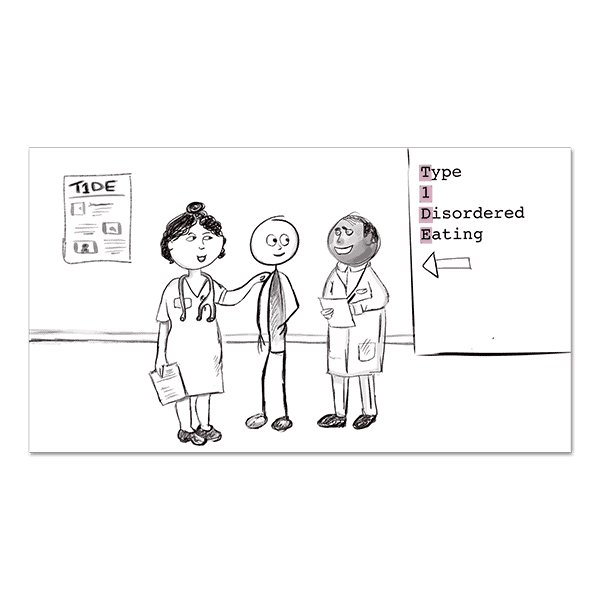
Adults from Wales with type 1 diabetes and eating disorders (T1DE) participated in a therapeutic, creative project led by Breathe Creative, an arts-based company from Cardiff. Through virtual workshops, participants reflected on their experience of T1DE using creative writing, poetry, art and music, identifying common themes and key messages. The end result was a powerful animation of their collective experience and the need for continued awareness and further collaborative working among HCPs to improve support, treatment and outcomes for patients living with T1DE.
Innovation
Eating disorders in the presence of T1D has only recently been recognised as a mental health condition. Diabulimia has been used to identify an eating disorder, but this does not fit patients with variations in eating disorder behaviours. These include insulin omission, restriction or over-injection, food restriction, binge-eating, disordered or dysregulated eating and compensatory behaviours, which include purging, laxative/ diuretic overuse and over-exercising. The new MEED Annexe 3 guidelines on ‘Type 1 Diabetes and Eating Disorders’ propose diagnostic criteria and a diagnosis of T1DE. Exploring how T1DE impacts people’s lives is crucial to improving patient support, care and outcomes. The patient voice can create positive change. Adults living with T1D in Wales were invited to a virtual focus group to explore how having T1D may have altered their relationship with their body, weight and shape. Being a sensitive topic, representatives from BEAT led discussions and the clinical lead from Service for High risk Eating Disorders (SHED) was present. Participants expressed an altered relationship with their body, weight and shape and a negative, complicated relationship with food following diagnosis, and many engaged in T1DE behaviours. They were invited to explore their experience of T1DE and create an awareness-raising animation, led by Breathe Creative. The workshops were held virtually over Zoom, led by a trained counsellor and arts facilitator, Katja Stiller. Each session used therapeutic techniques to provide a relaxed, safe environment for reflection and creative inspiration.
Equality, Diversity and Variation
Adults from Wales with T1DE were invited to participate in the virtual focus group and follow-on creative project. Participants did not have to have a formal diagnosis of an eating disorder. Three females and one male were involved, with representation from the LGBTQ+ community and one with neurodiversity (ADHD). There were also Welsh-speaking participants. Participants were under different health boards, so could compare awareness of T1DE, interventions/treatment and support. Breathe Creative facilitated the virtual workshops, which were held in the evening. A paediatric diabetes specialist nurse attended to ensure that participants were safe in exploring their experiences. Eating disorder behaviours discussed were associated with anorexia nervosa and bulimia nervosa, disordered eating or insulin omission. All experienced eating disorder behaviours and a negative relationship with food and diabetes management. The majority had not had a formal eating disorder diagnosis and had their own coping strategies. Through drawing, painting, creative writing and poetry, they explored how their experience of T1DE did not necessarily fit traditional eating disorder labels, resulting in a lack of knowledge and support. It also helped to challenge Diabulimia as a diagnosis. The aim was to create a powerful animation to inform and educate HCPs, encouraging a wider perspective of T1DE and highlighting the need for a collaborative, multi-disciplinary team (MDT) approach. All participants completed the project. The animation is available in English and Welsh.
Results
There was 100% engagement from the participants. The animation was shared with HCPs across the Welsh health boards, plus charities, including JDRF, Diabetes UK and BEAT, and viewed at national eating disorder conferences in Wales and England. In Wales, it was viewed by the All Wales CYP Diabetes Network and the NCACE Arts and Health Event. The project was also presented at the All Wales Clinical Forum Steering Group and All Wales Patient Reference Group. The animation is a resource on T1DE on the JDRF and BEAT websites. There was a Parliamentary Inquiry into T1DE, and JDRF shared the animation on social media to coincide with this. It has also been shared by a support group in America, plus in Northern Ireland. Although this was a low-budget project (£5,000 AWDIG fund), the animation has raised awareness and encouraged discussions on T1DE. It has received over 1.1k views on YouTube, over 1.8k views on Facebook and almost 13k on Instagram. It has increased HCP awareness of the need for courageous conversations and collaborative working around T1DE. It has also been shared by Diabetes UK Research. In Wales there is funded national work for T1DE, with a funded All Wales Project Lead, a clinical forum steering group and local health board steering groups meeting regularly. MDT collaboration has been encouraged within diabetes and eating disorder services to improve communication, screening, referral and support. Consultation groups have been set up in diabetes and eating disorder services to enable early discussions on patients of concern, providing a better referral pathway. The clinical lead for SHED appointed the first Highly Specialist Diabetes Nurse in 2022.
User Feedback
Following positive feedback from BEAT and JDRF the animation is embedded in their websites. Importantly, it has given a voice to those experiencing T1DE. BEAT has launched its first CPD-accredited workshop on T1DE. Diabetes UK Wales sponsored the first All Wales Professional T1DE event in Cardiff in September 2023 in collaboration with the All Wales Lead for T1DE.
Dissemination and Sustainability
The animation has been shared nationally and internationally, being accessible on YouTube and shareable across multiple platforms. it has reached thousands of people, giving them an opportunity to voice their own experiences of T1DE. The animation is timeless and will remain relevant to people living with T1DE. Phase two of the project, Courageous Conversations, is underway with further funding from AWDIG. Participants are exploring T1DE through their individual experiences and producing projects to be shared nationally and internationally. The first All Wales Professional T1DE event enabled HCPs in diabetes, mental health and eating disorder services to learn more. HCPs working with patients living with Hepatitis C heard about the animation and funded their own creative project with Breathe Creative.