Summary
Over the last three years, the paediatric diabetes team at Surrey and Sussex Healthcare NHS Trust (SaSH) has increasingly embraced using insulin pumps, continuous glucose monitoring (CGM), Diasend software, Carelink Professional software and electronic communication with patients. A diabetes-specific database was also created locally for collecting statistics and data submission to the national diabetes audit. The SaSH team now has 45% of patients on insulin pump therapy (well above national average) and 7 patients on CGM. The software is used for every patient to download their blood sugar profile during clinic visits, thus facilitating focused patient-centred consultations. The new approach has improved glycaemic control and increased patient engagement and confidence, ensuring that when patients leave paediatric services they are confident and self-reliant in managing their chronic condition.
Results
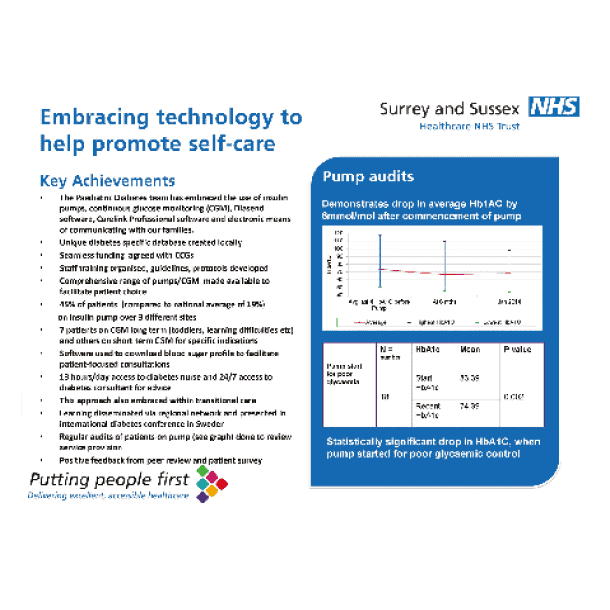
As seamless funding from the CCGs was secured, 45% of SaSH patients are on CSII compared to the national average of 19%. There are now 7 patients on CGMS (5 patients under 5 years of age, 1 patient with learning difficulties, 1 patient with poor glycaemic control and unexplained hypoglycaemic episodes). Obtaining Diasend software for the team and family has meant that almost all patients were able to have their blood glucose meters downloaded and reviewed in clinic and at home. An audit on use of CSII in June 2014 showed an overall drop of HbA1c from 8.9% to 8.4% on commencement of pump therapy at 18 months after initiation of pump therapy. There were no funding problems for any of our patients requiring CSII therapy, compared to a national decline rate for funding which was 9% and funding issues of 13%. The number of patients on CSII was an improvement from an already high percentage of patients on pump therapy in 2009. An audit done in 2009 demonstrated that 26% of the patients were already on pump therapy at that time. Now this figure stands close to 45% as per our audit done in 2013. This showed a statistically significant improvement in HbA1C in children starting CSII therapy (HbA1c 83.39 to 74.39, 95% CI 0.02 to 0.8, p value = 0.002.
Challenge
Surrey and Sussex Healthcare NHS Trust (SaSH) has a small but strong diabetes team caring for 240 children and young people with diabetes (CYPD). SaSH covers a population of half a million and a very large geographical area, with paediatric diabetes clinics run at 3 different sites - Redhill, Crawley and Horsham – plus transitional clinics. In order to manage the increasing work load, embracing all available new technology to improve ease of communication within the team and with families was felt to be the way forward.
Objectives
To maintain continuous ongoing support in between clinic, home and school visits and improve patient-centred care. To use technology to enhance self-care management and improve quality of life for patients and families. To enable the team to improve their skills and knowledge, fostering team working and improving communication within the team working at different sites. Finally, to improve outcomes, measured by HbA1c.
Solution
Agreement was obtained from the Clinical Commissioning Groups (CCGs) to fund continuous insulin infusion (CSII) therapy for the eligible patients. The diabetes team worked closely with the finance department at SaSH to secure funding for continuous glucose monitoring system (CGMS) for a number of patients - particularly applicable to children with learning difficulties and the toddler age group, to enable carers to minimize hypoglycaemic episodes. The team also secured funding for the use of Diasend software and Carelink Professional during clinical encounters. All members of the team completed training in the various aspects of technology use, drafted guidelines and provided training sessions to help the wider paediatric and emergency department teams. The team provided ‘pump demo’ sessions during which the families were shown all the available insulin pumps with their functionalities to enable them to make an informed decision.
Learnings
Communication is vital to the success of any team. The tools of the diabetes database, audit, multi-disciplinary meetings, regional network meetings, CCGs meeting and the strategic clinical network meetings were used as a means of communication within the team and with the wider network. Staff training is also crucial – the team can lag behind parents, who very quickly become experts in use of pumps and CGMS, unless training is kept up to date. Acute paediatric ward staff, who were unfamiliar with CSII therapy, were actively encouraged to attend teaching sessions to help in-patients. There is also a diabetes liaison nurse who provides the link between the specialist diabetes team and the ward staff.
Evaluation
Embracing technology has meant that, patients on pumps and CGMS have demonstrated an improvement in their glycaemic control. From the PREMs Feedback, it was evident that the team performed better than the national average in making technology available to patients, thus helping them manage their diabetes at home effectively. The DQuINs (National Diabetes peer review programme) review of the unit’s performance highlighted the following as ‘Good Practice/Significant Achievements’:
- 45% of patients on pumps
- PDSN Support for patients between hours of 9am to 10pm and also at weekends 10am to 6pm
- The diabetes database developed locally
- Comprehensive range of the different make of pumps available to patients which is good practice