Summary
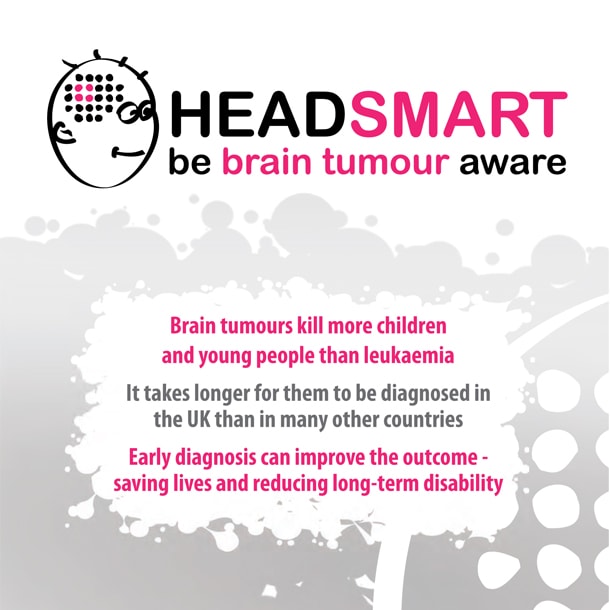
One quarter of all childhood cancers occur in the brain – 10 children and young people are diagnosed with a brain tumour each week in the UK – and they are the biggest cancer killer of children and young people.
Early diagnosis can save lives and reduce long-term disability but the average (median) time between symptom onset and diagnosis (symptom interval or SI) is longer in the UK than in many other countries.
‘HeadSmart: be brain tumour aware’ is a publicity and awareness campaign developed to bring about earlier diagnosis and improved outcomes. Against the primary goal of a reduction of symptom interval, the evaluation results showed a reduction in the median length of time to diagnose childhood brain tumours from 14.4 weeks to 7.5 weeks within a year of launch of the initiative. The latest figures to May 2013 have shown a further fall to 6.9 weeks.
Challenge
The UK performs poorer than many countries when it comes to the length of time to diagnose brain cancer in children. HeadSmart: be brain tumour aware is an initiative produced by the Brain Tumour Charity to address this issue.
Previously published reports showed there had been no reduction in the UK between the time taken from symptom onset to diagnosis (14.4 weeks) in two decades, yet many other comparable countries were reporting much shorter intervals (as little as five weeks).
Delayed diagnosis puts children at risk of increased life-long disabilities and poorer survival rates. Government initiatives had failed to improve the speed of diagnosis and the children and young people who take the longest time to be diagnosed make multiple visits to healthcare services before their tumours are discovered.
Objectives
The need for a targeted, creative and innovative initiative involving both the public and healthcare professionals was clear, so the charity launched its campaign with four objectives. These were to:
- Reduce the reported median time from symptom to diagnosis from 14.4 weeks to less than 10 weeks, and ultimately to five weeks
- Achieve prompted awareness of 10 per cent among the public of the HeadSmart campaign
- Achieve prompted awareness of over 50 per cent among healthcare staff
- Achieve a 10 per cent increase in the confidence of paediatricians to diagnose brain tumours.
To meet these goals the team needed to develop evidence-based clinical guidelines requiring national funding, and a campaign to disseminate these guidelines to the profession and the public. It had to promote and distribute age-appropriate guidance, design a support website and launch a smartphone app to help parents and healthcare professionals identify those children and young people who require an urgent or timely scan.
The charity also needed to align the campaign with national health priorities across the UK by targeting GP surgeries, health authorities and primary care trusts for their help in raising awareness of the campaign. To achieve this a clinical champion network was created and community champions were recruited to circulate materials and drive local press coverage and attended conferences, workshops and meetings to raise awareness of HeadSmart.
Solution
In conjunction with the University of Nottingham, the charity developed an evidence-based, NHS evidence accredited, clinical guideline, with endorsements from the Royal College of Paediatrics and Child Health and the Royal College of Ophthalmologists. The campaign secured support from the Royal College of GPs, the Association of Paediatric Emergency Medicine, the Children’s Cancer and Leukaemia Group (CCLG) and leading clinicians.
Funding from the Health Foundation allowed the campaign to launch and the charity distributed over 500,000 summarised, age-stratified symptoms cards, launched a decision support website, an online e-learning module for health professionals and a smartphone app for the public and profession to urgently refer or exclude children for a diagnosis.
Quality improvement techniques were used to develop and test materials which were sent to all GP surgeries (624) in the East Midlands pilot area. SHAs and PCTs were briefed on expectations and outcomes and SHAs were asked to post news on their websites. Many community champions had experience of the devastating results of late diagnosis and used this to drive local press coverage and strong case studies were used to inform national press. The team also made extensive use of social media to drive campaign messaging to target audiences.
Results
The Brain Tumour Charity measured success by surveying public awareness of childhood brain tumours and their symptoms using contracted interviewers across the UK. Health professional awareness has been measured with web-based questionnaires, along with symptom interval data of newly diagnosed child brain tumour cases. Monitoring was implement for use of the website, social media pages and requests for HeadSmart materials.
The data showed a reduction in the median length of time to diagnose brain tumours from 14.4 weeks to 7.5 weeks within a year of launch. The latest figures show a further fall to 6.9 weeks. By November 2011, 11 per cent of the public were aware of the initiative, beating our objective of 10 pper cent and for healthcare professionals awareness was 60 per cent against our target of 50 per cent.
Confidence among paediatricians to make a brain tumour diagnosis rose from 32 per cent to 54 per cent, beating the target by 12 per cent. In addition, over 50 million people have been impacted by the initiative and case studies illustrating the value of symptom awareness.
Website unique visitors rose threefold since the first year, with over 5,600 unique users of the HeadSmart website every month and social media has proven extremely effective in disseminating information, with over 23,700 people liking the HeadSmart page.
Evaluation
Key learnings from the initiative are:
- Take the time to develop a strong evidence base to underpin your approach
- Have this evidence base recognised and your response (in our case, the HeadSmart campaign) endorsed by influential and credible healthcare institutions
- Develop a strong brand that will provide a plausible, trustworthy and reliable vehicle for your messages and actions
- Make innovative and enthusiastic use of social media and digital communications
- Take the time to engage and develop motivated networks of community and clinical champions
- Get out there: Maintain the visibility of your initiative at public, patient and professional events and conferences.
In this case, the campaign has been praised for its emphasis on reassurance – it is as much about ruling brain tumours out as it is about indicating urgent referral when symptoms are recognised. Don’t scaremonger in a way that creates an unnecessary or unhelpful burden on healthcare professionals or the system.
Impact
This project has three innovative attributes: It raises awareness and supports clinical decision-making; it supports parents, carers and young people to work in partnership with healthcare professionals to reach a diagnosis of a rare but extremely serious disease; and it uses national symptom interval data to drive change.
To extend the benefit of the campaign throughout Europe it was presented it to the European Parliament. This is leading to partnerships between health professionals and parents groups to promote a Europe-wide approach that will accelerate diagnosis through enhanced awareness of the range of red flag symptoms of childhood cancer, particularly brain tumours and bone tumours.
Several countries are looking to roll-out a HeadSmart campaign of their own. Groups in Denmark, Sweden, France, Germany, Austria, Poland and Spain are set to share best practice and target GPs and the public, encouraging them to think twice about certain symptoms.
HeadSmart was awarded the NHS Innovation Challenge Prize in 2013 in the Earlier Cancer Diagnosis category. The expert judging panel was impressed with the team’s ‘admirable motivation, determination, dedication, enthusiasm and leadership’ and noted that the project was impressive in design, delivery and engagement of the groups and agencies needed to be mobilised to make a difference.