Summary
In the UK each year 3,000 women are diagnosed with cervical cancer, and one third will die from the disease. However, it is a largely preventable cancer and the cervical screening programme saves 5,000 UK lives annually. But cervical screening attendance is decreasing year on year: challenges exist for women of different ages and from hard to reach groups, including those with learning disabilities. Jo’s Cervical Cancer Trust has created two different, targeted free health promotion tools which are made for these women, their carers and healthcare professionals, and aim to help informed choice, reduce health inequalities and raise awareness of prevention.
Challenge
Every day eight women are diagnosed with cervical cancer and three die from the disease. Cervical cancer is largely preventable thanks to the NHS screening programme and HPV vaccination programme. Across England 73.5% of women attend screening, yet for women with learning disabilities, studies have shown that nationally, uptake drops significantly to 13-29%. Approximately 2% of England’s population have a learning disability with the number of people with learning disabilities projected to rise to between 10 and 14% by 2020. Yet people with learning disabilities are 45% less likely to be screened for cancer.
Our initial work with women with learning disabilities has shown that often they do not understand the reasons for screening, how it is performed or their entitlement to screening. Sometimes carers (and clinical staff) cannot understand the benefits or necessity of screening.
Objectives
To ensure that appropriate health information resources are available for women with learning disabilities, their carers and healthcare professionals about cervical screening. To reduce health inequalities and to work collaboratively with people and organisations who share our vision. To increase the uptake of cervical screening in women with mild and moderate learning disabilities living in South West England by distributing the film to GP practices and evaluating the project locally.
Solution
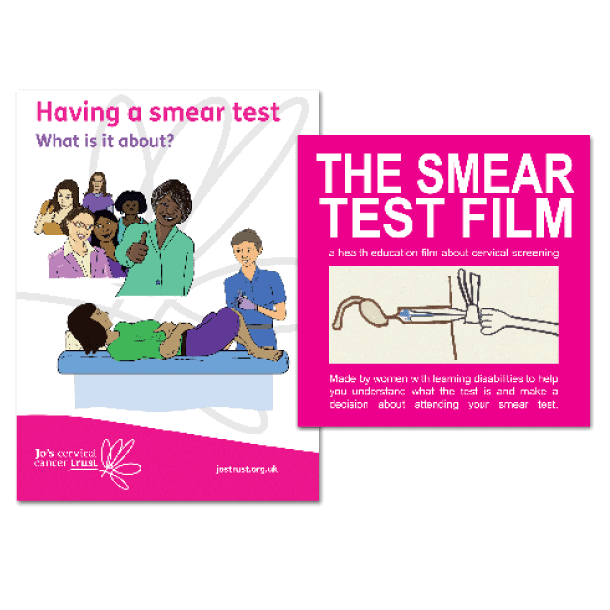
A film and a guide were produced to demystify the cervical screening procedure. The Smear Test Film used real life actors with learning disabilities to make women more comfortable with the procedure. Produced and directed by specialists in producing films for people with learning disabilities, the film’s advisory committee included representatives from Public Health England and Bristol City Council as well as Jo's Cervical Cancer Trust. Feedback prior to final edit was given by local learning disability nurses. Content of the EasyRead guide: ‘Having a smear test. What is it about?’ was shaped by feedback over nine months, with new illustrations commissioned as a result. Promotion has been done using existing networks, email marketing, and social media promotion.
Results
Since the film was launched in February 2015 there have been 3,588 views on YouTube, 95 orders and 546 DVDs sent out. Of these, 64% have been received by healthcare professionals. The majority of orders were from England, probably due to Public Health England’s involvement with the production of the resource and therefore promotion may have been focused in England rather than other parts of the UK. Within South West England, 600 DVDs have been distributed and 400 GP practices have received them. Since its launch in June just under 2,000 copies of the EasyRead have been distributed (180 orders received). Informal feedback has been incredibly positive and formal feedback will be sought early in 2016.
Learnings
Data from research commissioned by Jo’s Cervical Cancer Trust has shown that increasing screening uptake brings financial benefit to the state, NHS and the individual – getting women in screening is beneficial in all respects.
Evaluation
Three months after receiving a DVD, Jo’s Cervical Cancer Trust audits all those that ordered the film using an online evaluation survey. 63.6% said that they believed the film has aided women with learning disabilities to make a decision about cervical screening attendance and 13.6% saw an increase in the numbers of women with learning disabilities attending screening since they showed the film. All thought the quality of information and suitability of this film for women with learning disabilities was excellent or good. Public Health England will be using a mixed methods approach to evaluate the work, including quantitative data, pseudo-anonymised data collated before the intervention (film) and 12 months after with women registered as having a learning disability, and qualitative data such as from focus groups. Evaluation of the guide will take place early 2016, with focus groups used to gain feedback on how it has been used.